Technology
A Technological Environment
Conversations about the ethics of technology are often met with the response, “technology is just a tool. What matters is how you use it.” Like a hammer or a lever, it multiplies human capacity, allowing individuals and organizations to scale their efforts, automate processes, and reach wider audiences. “Any new technology,” it is said, “is a double edged sword — it can be used for good, or for evil, but the tool itself is neither.” We can do a little better than that, I think.
Take a look at a workman's tools. Their leather handles wear down and groove into his particular hands. He maintains them himself. He may have even forged them. His tools, he grasps with his hands, wrapping his hand around them. The tool is fully in his control.
More complex tools, like a drill press, lathe, or a milling machine belong in the workshop but are not held in the hands of the workman. As a rule they are not made by the workman, although he usually maintains them himself. But certainly, full control of the machine lies still in the hands of the workman. The total result of the action of the machine is again right before his eyes.
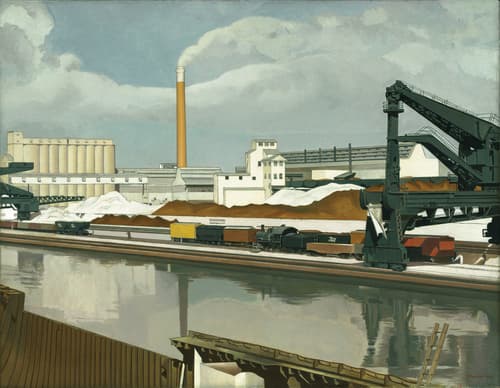
A step above the workman, in the historical development of our tools, is a crane. The crane operator does not wrap his hands around the crane. He doesn’t repair it himself, and he certainly didn’t craft it. But the crane operator fully controls the crane. Nobody else, outside of the job site, is controlling the crane. The full action of the crane is again before his eyes. To varying degrees, the workman wields this hammer, the crane operator wields the crane.
There are however, more recently developed technologies that are not characterized at all by any of the normal features of a tool. A social media platform is certainly not crafted, maintained, or held by the user, unless that user happens to be the CEO of a tech company. A social media platform is not wielded by the user. It is not grasped whatsoever by the “user.” The full results of the use of the platform (posting, commenting, liking, forwarding) is neither in the control of the “user” or their gaze. And yet, the same language of “tool” is used to describe these platforms, and they are betrothed the same neutrality as the hammer — the moral component resides in the user.
Arthur Asa Berger, professor emeritus of communications at San Francisco State University, argued in a 2020 Pew Research canvassing that “Innovation is a two-edged sword: It can be used for negative purposes (new viruses, for example) or positive purposes (diagnose medical problems using smartphones). The development of Twitter is now used as a propaganda tool by the president — a negative innovation as I see things.” The sword language suggests that this “propaganda tool” is wielded, grasped by both hands, fully controlled. The president, sword wielder, is the moral agent.
David Bray, a technologist and internet policy leader, articulates this same instrumentalist position: “Technology is a tool. Just like stones can be used to build walls to build shelters, but they can also be used to harm people, it’s really upon the choices we make as people and as communities, to make sure that they are a force for good in the world.” The analogy between using stones, a natural material, to build walls for a shelter, and a social media account disseminating information across a social network, is stretched very thin, but this is the typical language to describe this new wave of technologies. The metaphors we use for the new technologies we have today, platforms, create a semantic field of familiar, more basic technologies, like “swords” and “bricks” and “hammers,” even “printing press” and “automobile.”
All of the above can be used for either good or evil, but are essentially neutral with the possible exception of the sword and rifle. Although proponents of the 2nd amendment will say, “guns don’t kill people, people do” — the same appeal to moral neutrality of the tool, charged morality of the user.
Is there not some sensible way to say that a social media platform has a “user” or a “wielder?” The consumer is only a user in a partial way. They don’t create, maintain, see, or wield the technology. Who does these things? The engineers create and maintain the technology, although no single engineer has the sole claim of creator. The engineers tweak the nobs and dials of the platform to make it run in a certain way. They set the conditions and design the platform. They are the software “architects.” But even these platform providers are not fully in control of the conditions of the platform.
The social media “algorithm” selects the content that is shown to the user. The algorithm selects which “creators” to push. But the algorithm is not fully in control of the engineers that initially created it. YouTube, TikTok’s For You Page, Facebook’s feed — are trained systems whose emergent behavior genuinely surprises their creators. The outputs aren’t designed row by row; they arise from optimization processes running against billions of data points. Engineers can specify the objective function but not fully predict or explain what the system learns to do to achieve it.
A social media platform, it seems, is not created, maintained, wielded, or gazed at by any user. It is a different kind of thing. So, what is it?
A social media platform might be more similar in kind, at least in analogy, to a theater. There is an audience (the “user”), a creator (writer, director, set designer, actors), and a platform (the stage, the theater). Without any of these components, the theater, or the social media platform, ceases to exist meaningfully. The audience and the creator and the platform all need one another. They are in a bound symbiosis, and they have to cooperate with one another. A theater without creators or audiences is a liminal space that doesn’t display its essence. It can be gazed at in all its glory only with all three components. It is not describable in terms of its raw materials. Least of all is a theater a tool.
A theater, or a social media platform, are more like places where things happen than they are anything like a tool. In other words, they are environments. Environments are best described in terms of niche construction: The environment exerts a selection pressure on the organisms within it, which changes the environment — a coupled system. In other words, the theater demands something particular from the creators, which attracts an audience, which demands something particular from the creators. If the audience hates to see pantomime, the creators will change. If the creators need different kinds of lighting to please the audience, the theater will change. All three elements are constantly changing and responding to each other’s changes.
The analogy with a social media platform is particularly strong. The platform needs both creators and an audience to function. The creators will change their art depending on what the platform requires: the newspeak phrases like “unalived herself” (because the algorithm seems to suppress creators who say “committed suicide”) and creators converging on the same kind of hooks because that is what the algorithm pushes (“you probably don’t agree with this,” “you need this,” “I wish I knew this earlier”).
But the audience is changed by the theater, too. Aristotle argued in the Poetics that tragedy achieves catharsis — a purging or clarification of pity and fear — through the audience’s emotional engagement with the action onstage such that witnessing suffering at a safe remove produces not mere sensation but a kind of psychological reordering. Brecht inverted this deliberately — he designed alienation effects (Verfremdungseffekt) specifically to prevent the audience from being absorbed because he believed conventional theater produced passive emotional identification rather than critical thought. His critique assumes the transformative power is real and dangerous.
In the case of the social media platform, the audience exists also under selection pressures. For one thing, audiences switch environments: When Twitter became X, some liberals left for Bluesky, and some libertarians and conservatives joined X. Migrations of flocks. But within a single platform, and within a single user, change takes place too.
Facebook’s own internal research, revealed by whistleblower Frances Haugen in 2021, showed that the platform’s engagement-optimizing algorithms amplified emotionally provocative and misleading content — evidence the company had largely kept from public view. Earlier, psychologist Ethan Kross and colleagues demonstrated in a 2013 study that Facebook use was associated with declining well-being and increased social comparison, suggesting the platform was changing its users in measurable ways even then. Academic research on this subject is amazingly thin and old. To an extent we have to rely on our own experience and collective consciousness of the effects of these platforms. The conventional wisdom is that our attention spans are shortening. Or look at the ascendant phrase “brain rot.”
Moving away from describing social media platforms as “tools” and toward describing them as “environments” is a moral distinction, not a language-for-the-sake-of-language one. We say “it’s just a tool,” but we also say, “he grew up in a bad neighborhood.” An individual under conditions is understood both as a moral agent in that environment, culpable for their actions, but the environment is also responsible for creating them. Both the technology and the “user” are morally charged. Similarly to how we say that a certain environment can produce criminality, we might say that the conditions of a social media platform are so overwhelming that we must change the environment before expecting the “user” to change.
Similarly, we might wish to abandon the term “user” with respect to social media platforms. It implies the wielder of the tool, who grasps the tool, and who is the only moral agent in the equation. Nobody would say “the user of the environment.” Nobody would call the audience, or the stage actor, a “user.” Perhaps we wish to say “subject” — in the philosophical/psychoanalytic sense, someone who is both an agent and who is produced by their conditions. It has the advantage of carrying the double meaning — a subject acts, but is also subjected to something. It also nods toward the royal “subject.”
The term “platform” is also one in which moral conditions are buried. Facebook and other social media companies have long sought legal and moral shelter under the claim that they are platforms — mere conduits for user-generated content, analogous to a telephone network or a bulletin board, rather than publishers who exercise editorial judgment. This argument has a legal basis in Section 230 of the Communications Decency Act, which shields platforms from liability for content posted by their users. The platform-not-publisher distinction is, in other words, the legal codification of the tool argument: We built the space, but what happens inside it is not our responsibility.
But this is precisely where the environment framing becomes legally and philosophically consequential. A theater owner who designs a venue that reliably produces riots cannot claim neutrality about the riots. They “architected” the environment. Facebook’s decision to optimize for engagement, to algorithmically amplify emotionally provocative content, to design infinite scroll and variable reward notifications — are not neutral infrastructural decisions. They are the equivalent of a landlord who builds the neighborhood. The platform-not-publisher defense depends entirely on the tool framing holding up. Once you replace “platform” with “environment,” the moral and potentially legal logic shifts: Environments have designers, and designers bear responsibility for what their designs predictably produce. Theaters have regulations: They have fire codes, occupancy limits, sanitation and bathroom standards, accessibility requirements. The theater is responsible for the plays it puts on.
The central moral claim of this piece is that both the environment makers and the “users” or “subjects” are morally culpable for what takes place on platforms and how these platforms reshape our minds and societies. But getting off of social media is very difficult! Social media is where the news spreads, where entertainment happens, where citizen scientists and journalists, writers and philosophers publish their work. Social media is where career development and employment is found. We gain a great deal from social media, but in its current form, we lose more than we gain. The dream I have is twofold. Philosophers, writers and artists ought to direct more attention toward having a proper philosophy of technology that is neither hubristic, doomer, or unduly optimistic. Only then can the second be achieved: We need to design better platforms. We need to imagine a social media that doesn’t optimise for addiction and division. We need a social media that promotes human flourishing, that is architected for appropriate use, avoids echo-chambers, promotes healthy but robust disagreement. We need a profit model that doesn’t rely on selling data to advertisers but is affordable and inclusionary. Call me when you find one.