Culture
Annals of Obscenity: Art, The Person
Sticks and stones may break my bones, but words can never hurt me. — If words can't hurt us, what can they do?
1
After printing Episode XIII of James Joyce’s Ulysses in The Little Review, the letters began to pile on Margaret Anderson’s desk. “I think this is the most damnable slush and filth that ever polluted paper in print,” one began (My Thirty Years' War 212). At least the letter writer’s handwriting was pleasing to Miss Anderson … because there was nothing else pleasing about it. In her response, Anderson does not equivocate in insisting that, more so than mere ink on paper, the matter at hand primarily concerns the people who put the ink there:
“You have heard me speak of James Joyce with reverence. And yet you did not hesitate to speak of him to me with grossness. … It is not important that you dislike James Joyce. It is as it should be. He is not writing for you. He is writing for himself and for the people who care to find out how life has offended and hurt him" (Thirty 213).
In her first blow to the crybaby letter writer, Anderson informs him of his faux pas. He had broken a simple rule of human relations, and there he stood in need of instruction — he had not been able to discover it on his own due to his “profound ignorance of all branches of art, science, life" (Thirty 214). The second blow — it only took two — made it clear to the letter writer that he was not someone whose opinion the illustrious Joyce cared about anyway. And all his letter proved was that the man who wrote it was unworthy of Ulysses. Joyce wrote for himself. Caring about Joyce, the man, made readers worthy.
2
Although Ulysses plays in a league of its own, Anderson’s defense of Joyce can be applied to any work of writing, provided the writer has faithful enough friends to make the argument for them, because there is no writer who does not write for their own sake. And if there is anyone who takes interest in the writing, it is because they take interest in the writer. But how is it that so many people take an interest in James Joyce — whom most of them have never met — that they decide to read his book? I mean, he’s really just an ordinary fellow.
Let us not forget that there are available to us, even after his death, some extraordinary images of him. In what survives of his likeness, his eyes always appear with great emphasis. His eyes, magnified beyond proportion by his glasses, suggest that he saw more than any of us might. The sometimes eyepatch over his left eye lends an air of mystery (who can resist a mystery in the shape of a person?). And his near-blindness recalls the visionaries Homer and Milton. When we open the pages and flap up the eyepatch, some simple truths about Joyce become apparent; like, for example, that he had read many books — and that these were a major part of the life that hurt and offended him.
But the ultimate discovery of reading Joyce, that floats like a hallucination over incredulous readers, is that he was a human being. The next important discovery, which comes chiefly with the contemplation of the fact that such fiercely rejected writing could still be in print today, is that he was a friend. If there had not been people willing to defend him when the matter got personal (and when is the matter of writing not personal?) then he could not have written anything still worth reading a hundred years later.
Even our 2,000 years’ distance from Plato has not been enough to quell our interest in the latter. This is only because, ever since he lived, he has always had friends and advocates.
3
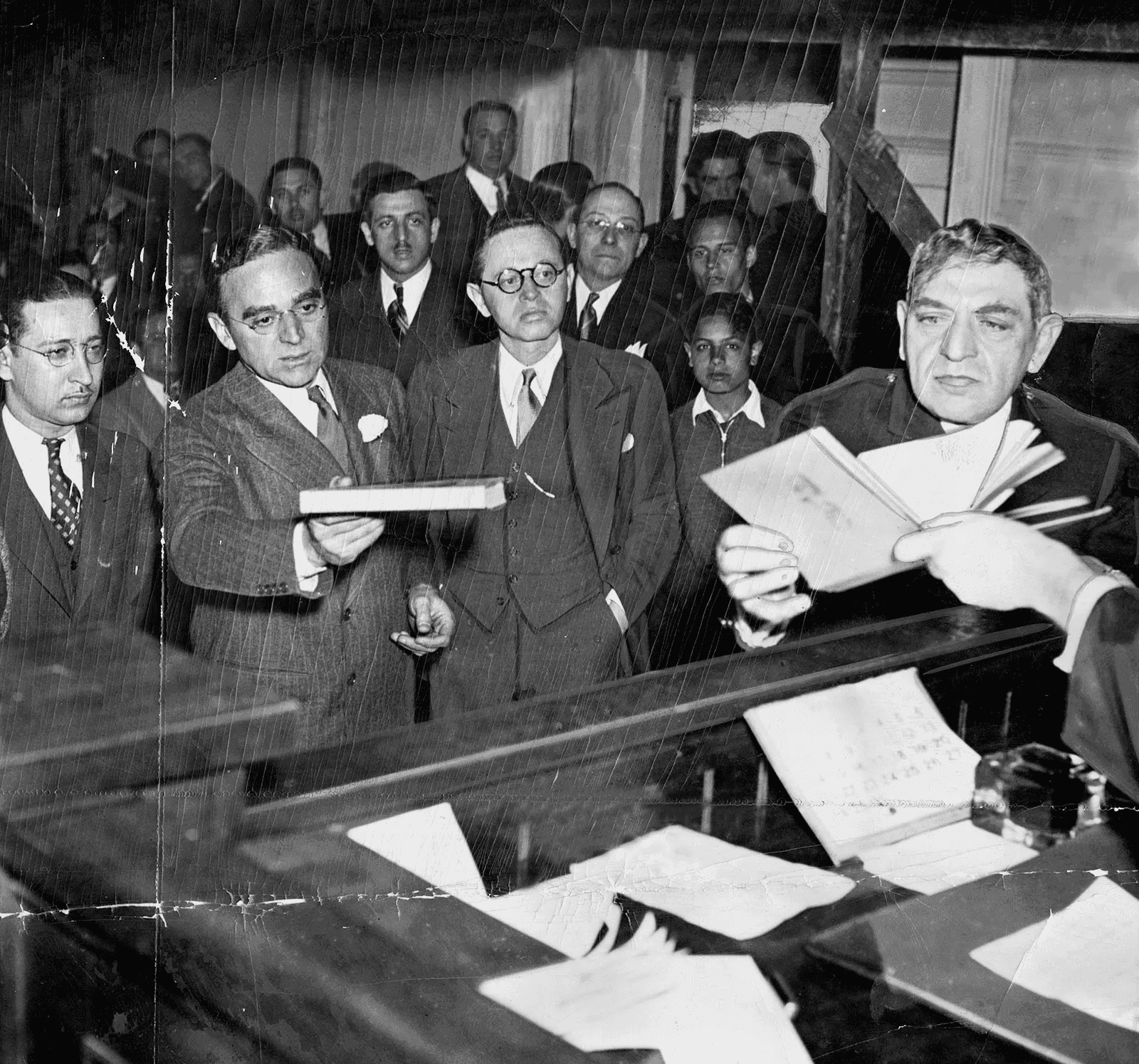
In February 1921, John Quinn defended The Little Review in court against obscenity charges. As part of his defense, Quinn presented three experts in literature to explain the merits of Ulysses to the drowsy judges.
But was it the compliment Philip Moeller of the Theatre Guild made it out to be when he, in his courtroom attestation to its merits, used Freud to explain Ulysses? Freud, after all, is useful notably for making sense of the incomprehensible ravings of madmen. And Moeller, like Freud, made himself sound like one, too, in the process of explaining; so much so that one of the white-haired judges requested that he “speak in a language that the court could understand" (Thirty 220).
In the end, the editors of The Little Review were found guilty of obscenity. Moeller had made no difference — except, if it hadn’t been for his act, there would have been no reason for the judges to awaken from their naps at any point during the trial.
Beyond this small victory, Moeller gave an example of how to be a person who reads Joyce. And there were many such examples in Joyce’s orbit. That is why anyone still cares about him today. Having people attached to a work — that is what makes it a classic.
4
What would it have taken for Joyce’s friends to give up on defending him? In the episode they were defending, the 38-year-old protagonist masturbates on a public beach while eyeing a young woman who is supervising three children. How much further can you go before your friends start to side with the Society for the Suppression of Vice?
It might have been the right decision to ban the episode from poisoning any more pages … if the same words had been written by a worse man than Joyce.
5
At some point during Quinn’s remarks, “one of the judges protested that he wasn’t interested in hearing anything about James Joyce,” and “that he merely wanted to discuss the obscene writing in question.”
In her autobiography, My Thirty Years' War, Anderson recalls how she wishes she could have, at that point in the trial, “rose from my seat to cry out that the only issue under consideration was the kind of person James Joyce was, that the determining factor in aesthetic and moral judgment was always the personal element, that obscenity per se doesn’t exist" (Thirty 220). But she had committed to Quinn’s plan to make her and her fellow editor, Jane Heap, appear to the court as “conservative quietly-dressed women and innocent boarding school girls" (Thirty 219). The plan worked so well that one of the judges refused to let the obscene passages be read aloud in their presence.
What Anderson would have said is what I mean to say, too: “The determining factor in aesthetic and moral judgments was always the personal element" (Thirty 220). In my own words: Nothing is said twice. Try to remember the time when two people uttered the same words. The first person speaks, and no one chuckles or chortles. The second person speaks the same words, and the room erupts into laughter. The words we use are not the same when anyone else uses them.
So, if there is anything about literature that transcends the human power of description, it is whatever appears subtly distinct about an individual in their delivery of what has inevitably already been said. And, therefore, I believe that if you could ask Anderson what makes Ulysses so great, she would say, “More than any of the things that would sound clever to say about the book, it is great because it was written by James Joyce.”
6
The democratic critic decides what’s funny based on who’s laughing.
It is so with words. Works of writing were once made to please the royal and the noble. As long as writing pleased the powerful, all people were pleased, and the continuation of the craft was guaranteed through patronage. Now, the power of royalty exists in everyone who lifts their voice above a crowd in need of direction. And whoever can say what they think good art is, as self-assured as a queen, will be treated like one by all who seek to think for themselves in exactly the way she does. The royals are now more abundant. They are held in such high esteem that the art of their time is magnetized into the realm of their tastes. But this is not so mystical as magnetism. Much simpler: The artists aim to please whoever’s tastes are well-known.
7
In an issue of The Little Review published not long after the trial, Anderson further describes what she would have stood up and said had she not, albeit hesitatingly, agreed to maintain an air of vacuity in the courtroom. She says the matter of “who is the author?” is “a rather fundamental matter … since Art is the person —!” ("Ulysses" in Court 23). I admit that Anderson takes the point further than I intended to take it when I first set out to write about writing. All I had in mind from the beginning was to say that the judgment of writing’s merits depends entirely on the social relationship between the judge and the judged — without seeing any need for a separate case to address the parasocial. But Anderson takes the point further by giving focus to the individual rather than to the relationship between individuals. And this “Art is the person” is her most radical formulation of the idea — although it may sound rather familiar to us today, as we are accustomed to having to respect others’ tastes in art and to keep a secret of our belief in our own taste’s superiority.
Anderson sees Ulysses as an embodiment of Joyce. She understands, then, why the book, being an embodiment of something unseen to them, would inspire fear in the hearts of those who do not know Joyce.
If it were possible to meet a man’s characteristic without meeting the man himself, then we would surely never think he was a creature worthy of our love. This was the vantage point of the judges. Where was Jame Joyce when his writing was on trial? Absent. Try as they might to characterize him in court, Joyce’s friends could not do any better than Ulysses itself to summon the real presence of an absent being. Perhaps if the judges could have lunched with Joyce … afterward, they might have been able to see Ulysses in the bleeding light of humanity in which all writing deserves to be seen. But, alas, the lunch would not have gone so well with such a precarious chandelier of pretense over the table. And so, they would not have been able to enjoy — let alone try to understand — Ulysses.
For the same reasons, people sometimes refuse to enjoy each other. When we are introduced to some one characteristic alone — and perhaps it is sometimes a truly loathsome one — we will gag at the prospect of meeting the repulsive creature in which that characteristic makes its den. And if you do happen to meet the creature, it takes a great deal of strength on the part of both the judge and the judged to bring that characteristic into a light under which it can be overlooked.
“The Art is the person.” And if this is true, then Art is also subject to all of the shortcomings of persons. Art has its disgusting vices and towering virtues. When the vices are displayed by themselves — as they can only be displayed — the person will seem to be only the vicious beast he sometimes is. But a complete view of the human being … is there one? Could Joyce, even if he had been present, have appeared fully as the being he is? He could not have. His friends’ idea of his goodness was influenced by a dizzying array of coincidences that could not have been reproduced before the eyes of impartial judges. It was a noble effort, and well in tune with the meaning of art, for his friends to try to make the judges see what seemed to them good in Joyce. It was also futile. Because to only see what is detestable is habitual for those who lack the capacity for thought. But to look at what is detestable and see that it is beautiful — this is a muscle made strong by exercise.
No matter how hard they squint, the judges cannot see the whole. They look at pieces and think their eyes are skilled enough to detect some strand of DNA, when really they are only gawking at the empty spaces between particles of matter. They don’t even realize that there exist two distinct considerations of whole and part. “Their only function is to decide whether certain passages of Ulysses … violate the statute" ("Ulysses" 23). And they decide the passages do just that.
9
In the end, the story of the trial of Ulysses in The Little Review leaves us only with a negative answer to our question of what words can do. It is only clear now that words do not have the power to win over any given reader with any given excerpt — just as no human being wins the favor of a friend by means of one body part alone. In this way, writing is very much like a person. It is limited in the same way. But it is unfair to call this a limitation when it is only in accordance with the universal fact that great things are great with respect to their whole being, not with respect to any given part on its own. It would be dehumanizing and humiliating for Ulysses if it had only one appendage, among its many, with respect to which alone it was considered great.
So let us leave it with this: The court charged a hair on Ulysses’ rear for not being an eyelash instead — a charge to which no gem of human greatness is immune.
10
I hesitated to write any of this for fear I would regret piercing the illusion that we have had, now and then, writers of objective merit in our presence. But now I laugh at myself for thinking a mere writer could ever hurt such an ancient edifice.
Works Cited
Anderson, Margaret. My Thirty Years' War. Covici, Friede, 1930.
Anderson, Margaret. "'Ulysses' in Court." The Little Review, vol. 7, no. 4, Jan.–Mar. 1921, pp. 22–25.