Technology
Artisanal Intelligence
The finished object almost always conceals the process that produced it. An apprentice tries to follow the example of past masters or imitate an ideal finished product; errors occur, revisions are made if the work isn't completely ruined, or sometimes a fresh start is needed when nothing can be salvaged. This process repeats until the work provides some satisfaction and the apprentice gains enough proficiency to begin a new skill. Before the birth of universities and widespread availability of classrooms, this sequence of skill acquisition was learned in a variety of spaces: the workbench, the potter’s wheel, the kiln or the hearth. In these spaces, a master demonstrated a technique, often without explaining it; the apprentice imitated, fell short, and tried again; and when something went wrong, it was the master, or an experienced practitioner only a few years further along, who showed them where and how it could be improved. Writing and other intellectual skills have often been learned in much the same way. In antiquity, students of rhetoric learned to compose by imitating respected orators, and writers have since apprenticed themselves to authors they may never meet, reading them closely and working out for themselves why a sentence works.
In this light, what the finished object conceals is not only a process, but what I term a type of artisanal intelligence — that is, a disposition rooted in practices of craftsmanship where skills are developed and allowed to mature through a sustained engagement with the material. Artisanal intelligence, as the name implies, draws on a long history of knowledge and the transmission of experience, techniques and skills between artisans and apprentices. From the workshops in Cremona that produced Stradivari’s instruments to the community of San Bartolo Coyotepec in Oaxaca that continues to produce barro negro pottery, artisanal intelligence is a disposition developed at both the individual and communal level. It is an intelligence that resists the urgency of our contemporary fetishization of speed and pseudo-productivity.
As an academic librarian teaching information literacy, my interest in the philosophy of craftsmanship has been spurred by the effects I see of generative AI on higher education over the last nearly four years. Generative AI has disrupted how students are assessed, how they engage with course material and reading and how they approach thinking through the writing process. Artisanal intelligence resonates with my practice. In academic skills sessions, like craft workshops, librarians take on the role of a more experienced artisan. They present the skill being covered (e.g. critical reading, note-making, academic writing, etc.), model the skill in real time, for all its dangers and benefits, and, in the time designated for attendees to experiment on their own, circulate around the room overlooking the work and addressing questions as they arise. We realize that students will rarely master the skill in the space of an hour. Yet, we know that with continued practice and support they will grow in competency as they encounter challenges, revisit techniques when something doesn’t quite work, and become skilled practitioners able to adapt their research processes when they encounter new conditions or technologies. Mastering foundational skills through artisanal intelligence is what allows us to adapt our practices once we have found the familiar beneath the novelty of generative AI.
Learning in the workshop
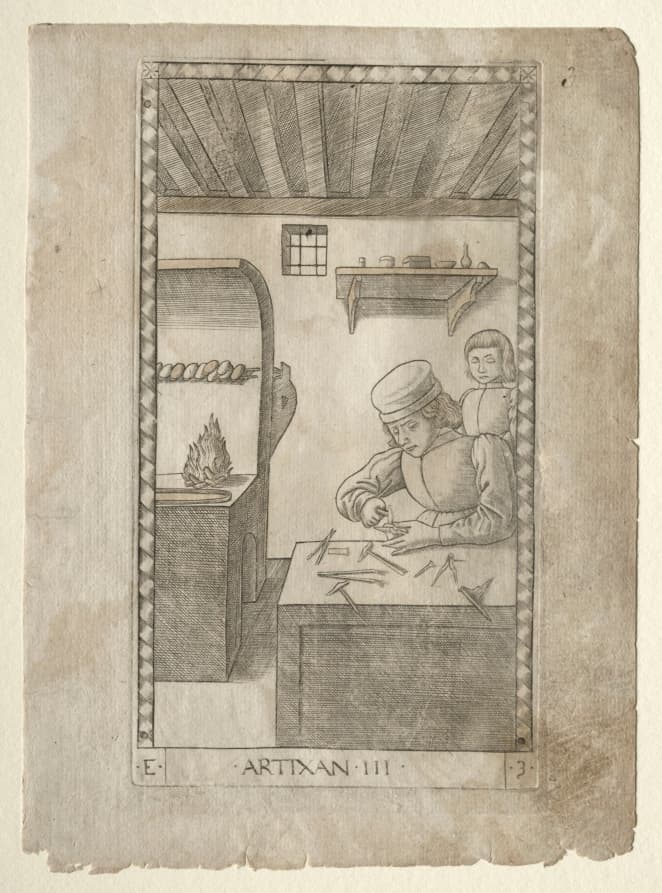
One defining feature of artisanal intelligence is expressed in the teaching relationship between a master artisan and an apprentice. For scholars of craftsmen and guild history, providing transferable skills to apprentices was one of the reasons trade guilds emerged in preindustrial Europe. For scholars like Bert de Munck, the process of acquiring artisanal skills occurred on the shop floor in an active “process of learning by doing” (De Munk 98). In this process, master craftsmen demonstrated the techniques of the trade, scaffolding activities proportional to the skill being practised; apprentices observed and imitated the process; and through a cycle of trial and error, they gained proficiency or, when needed, received support from the master or a more experienced journeyman.
The relationship between a master artisan and an apprentice was not only regulated through contracts between the apprentice’s family and the artisan, but also through an evaluation of the master’s practices by peers in the relevant trade guild. In the first instance, contracts between both parties stipulated fees for the master’s time and potential loss of materials, the length of service for apprenticeship, and the financial costs of boarding and lodging. In loco parentis, the master artisan served as a father figure to his apprentice, ensuring that the acquisition of artisanal skills was also accompanied by moral and religious education. If a formal contract was not sufficient to hold a master artisan to his responsibilities, guilds could also levy penalties if he failed to train an apprentice in the agreed skill or if he tried to take advantage of an apprentice through enforced cheap labour.
Part of what passed through this relationship between a master and an apprentice is what Pamela H. Smith terms an artisanal epistemology, that is to say a mode of gaining knowledge contained in “preindustrial craft practices,” the writings of practitioners, and the transmission of “experience” through imitation and the “replication of natural processes” (5). Smith notes that this epistemology emerged in part from apprenticeship itself, where observation, imitation, repetition and active doing were at once modes of work and of transmission. Her interest lies in what grew from the workshop: the artisans' claims to certain knowledge of nature and the authority those claims conferred. My interest, however, lies in the workshop itself, in the practical, moral, and social education by which a novice becomes a practitioner. By artisanal intelligence, I mean the dispositions that can be cultivated within a formal workshop setting and beyond, a definition that allows me to draw on cross-cultural expressions of artisanal practices even when guilds are no longer present.
A more recent example of this artisanal intelligence is found in the community of artisans producing barro negro in San Bartolo Coyotepec, Oaxaca, Mexico. While Zapotec and Mixtec communities have produced clay pottery in the Central Valleys of Oaxaca for the last 2,500 years, the shiny black pottery the region is famous for emerged only in the mid-twentieth century, when Doña Rosa Real Mateo de Nieto noticed that underfired pieces often developed shimmering sections. Although artisans often set these pieces aside as flawed, Doña Rosa saw an opportunity to create something new. By polishing the surface of her pottery with quartz before sealing it in an underground kiln and underfiring it, she turned what was normally considered a flaw into a new technique.
What Doña Rosa discovered did not remain hers alone. Doña Rosa’s grandchildren speak of a grandmother who spent most of her adult life teaching them the technique she had found. Pottery remains largely a family practice in San Bartolo, made in home workshops “where extended families work side by side” and where the craft is learned from a very young age (Sachasinh). To be sure, the popularity of barro negro among collectors from the United States and Europe changed what was made: Vessels once created for functional use in milpa farming practices gave way to decorative pieces destined for the living rooms of cultural elites. It would be easy to read this as one more exoticization of the Indigenous other. Yet this would overlook how the craft itself persists through commodification: Whatever the market asks of the finished piece, older practices, such as shaping clay on two concave plates and firing it in an underground kiln, are still taught in home workshops alongside the technique Doña Rosa developed of polishing clay with quartz. Today, cooperatives such as Colectivo 1050° work with potters to return the craft to its functional origins and to cultivate what the designers Kythzia Barrera and Diego Mier y Terán call an “artisan mindset.” This slow transmission of craft knowledge from generation to generation; the adaptation, yet continuation, of a practice rooted in communal history; the ability to see in a failed piece the beginning of a new one: This is artisanal intelligence.
From pottery to pages
Moving from material to academic practice is not the most intuitive move at first. Most discussions of artisanal practices emphasize the dialogue between material and practice, hand and tool, in a continuous feedback loop between the material being shaped and the hand wielding the tool. Yet, for those who consider reading and writing a craft, the metaphors of material craftsmanship are never far removed. John Warner discusses the importance of modeling responses for students working through the writing process, and Susan Sontag, in Writers on Writing, describes how prose writers need to see their work to actively engage with it as they labour “in a lumberyard of words” (Sontag). Yet perhaps the biggest source of inspiration for applying artisanal intelligence to both material and academic practice comes from Peter Korn’s Why We Make Things & Why It Matters. Korn’s account of his journey into woodworking and furniture making begins by privileging the material over the immaterial. He discusses the separation of the practical arts from the fine arts in the Renaissance, the multiple craft revivals and their socio-political contestations, and, in a section on the difference between working with material and working with words, he states plainly:
“Working in the realm of words comes with risks and rewards. At the workbench I cannot bullshit a plank of white oak or a chisel; as mediums of thought they stubbornly ground me in the actuality of things” (155).
Yet, despite Korn’s indictment of the ambiguous nature of words, his written journey through the book reveals an attention to the creative impulse of craftsmanship; an impulse that unites working with wood, words and people under the “same essential endeavour” — the work of transforming thought into substance, be it pottery, a desk or a simple word (159).
Korn offers a second way of thinking about craft, one that concerns not only what is made but what is passed on through it: craft as part of a larger conversation about object-making, in which "knowledge gained through experience" accrues and passes from one generation to the next. Korn's conversation is conducted primarily through objects, but what it carries, “knowledge gained through experience”, need not remain within the confines of the workshop. C. Wright Mills’ “On Intellectual Craftsmanship” suggests that the same conversation can take place through reflection, notes and written drafts. Mills first circulated his essay among his students to help them form their own approach to the craft of sociological research. For Mills, that craft meant learning to use one’s own life experience in one's intellectual work: to reflect on it, record it, and let it inform the scholarship one produces. Reading Mills’ first draft alongside the version that appeared in The Sociological Imagination is instructive not only for how his voice changes, from an exploratory, first-person account of practice to a more imperative, advisory one, but for what stays the same. In both, Mills demonstrates rather than explains; he shares his own notes as models; and lays out his thinking as he interrogates his sources. In this sense, both the draft and the finished product reveal a master artisan demonstrating the skill apprentices should practice.
Reading slowly, over time
In The Craftsman, Richard Sennett discusses the value of organized, repetitive practice in developing a skill to a high degree. Repetition allows the practitioner to develop self-criticism, and if the value of craftsmanship rests on “the desire to do a job well for its own sake,” then repetitive practice is a fundamental ingredient in helping an artisan reach a state where their practice becomes problem-attuned, rather than focused on “getting things to work”. (20)
Reading and writing are two areas of academic skills that lend themselves especially well to a practice of artisanal intelligence. They are also the two areas where generative AI has had the biggest impact in higher education by offering users the ability to bypass the slow, repetitive tasks required to become a skilled practitioner in each.
Thinking over my own reading practice over the years, when I was a postgraduate at the University of California, San Diego (UCSD), I was fortunate to work as a teaching assistant for the Revelle Humanities Program. For someone who had gone to St. John’s College and immersed themselves in the Great Books program, this was nothing short of a dream job. A five-course sequence that works its way through the Western Canon from the Odyssey to Simone de Beauvoir, the pedagogical approach was strikingly similar: read the text closely, discuss the text in seminars, and write a focused paper on an argument from the text. Throughout my time at Revelle, I read and taught the same books multiple times, returning each year to my marginal notes and adding new comments or questions with every reading. This practice continued when I left UCSD and went on to teach survey literature courses at another university.
In preparing for this piece, I wanted to look back at some of my marginal notes in the books that have survived not only multiple moves but a change in profession as well. I was looking for layers of thinking I had recorded, evidence of chisel marks where I had grappled with a text iteratively. Wedged between Borges Fictions and Kafka’s Complete Stories, T.S. Eliot’s The Waste Land and other poems caught my attention. I loved teaching “The Love Song of J. Alfred Prufrock”. Taught in the same sequence as Kafka’s Metamorphosis, Freud’s Civilization and its Discontents, and Sartre's No Exit, memories of seminar discussions began to return: Is Prufrock a bug like Gregor Samsa? What role does civilization play in human happiness? Is Prufrock in Hell? I opened my worn copy and returned to some of my favourite verses:
Do I dare
Disturb the universe?
In a minute there is time
For decisions and revisions which a minute will reverse.
(Eliot 5)
Two marginal notes:
Carpe Diem!
Sapere Aude!
These were the notes from when I was in my younger thirties. At that time, I was immersed in reading the great books and having inspiring conversations with younger undergraduates, some of whom were not too inspired to be in my seminar because it was a required course, while others actively engaged in reading something unexpected as part of their STEM degree. Seize, or pluck, the day! Dare to know! In the face of uncertainty — intellectual or existential — have the courage to use your reason to know, even if it meets with unfavorable results. Reading further, new lines catch my attention:
For I have known them all already, known them all:
Have known the evenings, mornings, afternoons,
I have measured out my life with coffee spoons.
(Eliot 5)
Nearly fifteen years later, these lines resonate more now. What is the life measured out “with coffee spoons”? I have not lost hope in Kant’s invocation for the Enlightenment: Dare to know! Have the courage to use your own understanding to break out of the self-imposed immaturity, or dare I say ignorance, it is so easy at times to surrender to. In Kant’s time, the challenge was directed at those “guardians who so benevolently” defined the intellectual and physical life of the individual (54). After engaging with generative AI over the last several years, and teaching information literacy in the age of generative AI, the possibility of a rote automation of life takes on renewed significance.
What is the life measured out “with coffee spoons”?
I take my lead chisel and carve these new marks on the margin.
Between summaries and critical reading
The question is ubiquitous on nearly every webpage, every email, and every PDF. Would you like a summary of this? Beneath this question lies an offer. Rather than read, generative AI can tell you what you need to know. If you are involved in research, you will have noticed academic publishers are also reframing this offer as a type of hospitality: a “Reading Assistant.” One that helps you avoid the act of reading so efficiently that the loss goes almost unnoticed. A reader can arrive, but a reader is not required to enter. Where a distinguished journal once asked to be read, now its publisher only requires you to arrive — the rest can be told in ten bullet points or less.
Sennett offers a brilliant line to think with in light of the “bulletpointification” of reading when he writes, “The greatest dilemma faced by the modern artisan-craftsman is the machine” (81). This dilemma is not created by simply using a machine in one’s craft but by the machine’s ability to deprive the artisan of learning through doing. That is to say, the dilemma arises when the machine transforms the craftsman into a passive witness and a “consumer of competency,” as opposed to an active practitioner developing skills through “repetitive, concrete, hands-on training” (44, 52).
Information literacy sessions on critical reading demonstrate how librarians have attempted to keep students actively engaged with the practice of reading across a variety of formats and technologies. Concepts such as purposeful reading, SQ3R (Survey, Question, Read, Recite and Review), and the KWL Method (Know — Want to know — Learned) are often covered in critical reading sessions. Despite the variety of acronyms, these approaches all converge on the same point: Reading, whether in hard copy or electronic format, is a reflective practice that benefits from a repetitive, structured approach.
The overflow of information and abundance of publications is, to be sure, a problem worth taking seriously. It can be incredibly overwhelming when a student conducts a literature search on a research question and a library catalogue returns hundreds of results. It can be distressing when a student is time-poor, with a series of response papers due and not enough time to work their way through the readings. It is in moments like this that a slow, reflective pedagogy — an artisanal approach to skills development — is tested. It is here that the hospitable offer to summarize calls loudest.
For our part, librarians have taught speed-reading techniques to address the trend that more must be done with the same amount of time, if not less. Techniques such as scanning and skimming, where students are taught to work through a text quickly, are often the most sought-after skills in critical reading workshops. Scan the text for precise keywords and subheadings or skim the opening and closing paragraphs to get a general sense of the text’s argument, then decide whether the text is worth reading deeply. At first glance, these techniques might appear to teach the same type of reading that artificial reading assistants offer to perform. Yet, this would mistake the quantity of the text being read in the first instance for the underlying skill that is not being developed: the reader’s judgement. Where scanning and skimming require the reader to discern what is important through active engagement with the text, a quickly generated summary prevents the reader from exercising the skills needed to become a more critical reader. Without the opportunity to practice and experience the “desired difficulties” of a task, readers who rely exclusively on summaries and prompt-based interactions with a text risk either arrested skill development or the gradual, perhaps imperceptible, degradation of proficiency.
The Writing Workshop
In my earlier description of artisanal intelligence, I described it as a disposition developed not only at the individual level but at the communal one as well. While searching for information, reading, and note-making are skills that can be developed primarily at the individual level with support from more experienced practitioners, academic writing is a skill that lends itself particularly well to being developed in an environment analogous to an artisan’s workshop.
In classrooms and spaces heavily influenced by a process-oriented approach to composition, it is not uncommon for the following scenario to unfold:
Students are asked to bring two drafts of their writing to class, where they will exchange one copy with a classmate. As each student reads the other’s draft, they are asked to read with the following questions in mind to provide feedback: What is the paper’s central argument? Can you state it in one to two sentences? What part of the writing was unclear and why? Point out one area of the text that you thought was strong, and why? If you could make one improvement to how the text reads, what would it be, and why? After students have finished reading and commenting, the draft is handed back to the writer to read through the comments for a defined amount of time. When students have read through the comments and had time to process them, they discuss each other’s comments, working through the parts that seemed unclear or worked well. This step provides students an opportunity to further clarify their thoughts or discuss why certain writing decisions were made.
After having completed this process, the cycle is completed once again but with a different student so that by the end of the class they have had two readers provide provisional feedback on their drafts, two opportunities to discuss their arguments, and two opportunities to share their work with writers at similar or near-adjacent skill levels. All the while, the instructor hovers around the room. Listening. Evaluating. Interjecting when questions arise, drawing out unseen tensions in the feedback and posing questions for students to grapple with in their conversations.
The internal dynamics of a medieval guild workshop and the writing workshop both operate on the logic of learning by doing. Both are supervised by a master artisan/practitioner whose authority is legitimised by a developed and high level of expertise; in both, inequality of skill proficiency is experienced, and proficiency can be worked on collaboratively through a hands-on approach to the work. In fact, the terminology of the writing “workshop” is not accidental. Since the 1930s, creative writing and composition practitioners have drawn on the workshop’s artisanal association to emphasise its practical and communal influence in developing a writer’s craft. To develop voice and style, novices might start by learning the basic rules of writing, how to dissect the way language works, and how a more experienced writer moves from point A to point B in a text. Joan Didion’s description of her early writing exercises is akin to the training apprentice artists undertake by copying the work of past masters: to get into the perspective of another accomplished writer, she would type out portions of Hemingway's work word for word to feel how the sentences worked. Didion’s exercise is a true expression of the maxim “Writing is thinking”: an intentional, reflective, artisanal practice that creates space for self-reflection and the slow development of skill.
“Why can’t students ask AI to write an essay for them? If generative AI can write it and it passes, then maybe the assignment wasn't worth doing in the first place. The standard five-paragraph essay is just as formulaic as the generative text that emulates that template.” These are some of the predominant questions and critiques against the place of the essay as a form of critical thinking and understanding. If the refrains, “because writing is thinking” or “because writing is an important way to think,” are to resist being hollow, then writing, as well as other skills we find essential to the intellectual life, must ground itself in an artisanal intelligence. An intelligence that resists the industrial logic of speed and lifeless homogeneity, an intelligence that resists the flattening artificial outputs provided by large language models, and an intelligence that seeks to do a job well for its own sake.
The craftsman’s workshop needed to cultivate an artisanal intelligence has not gone anywhere. It is the classroom where students trade rough drafts, the library session where students explore the various stages of the research lifecycle, and the desk where a reader returns to the same book and adds a new note in the margin. The tools around it may keep changing, but what endures is what always has: a more experienced practitioner, a novice, and the work between them.
Works Cited
De Munk, Bert. ‘Apprenticeship, Guilds, and Craft Knowledge’. Encyclopedia of Early Modern Philosophy and the Sciences, edited by Dana Jalobeanu and Charles T. Wolfe, Springer International Publishing, 2022, pp. 98–104, https://doi.org/10.1007/978-3-319-31069-5.
Eliot, T. S. The Waste Land and Other Poems. Harvest paperback ed, Harcourt Brace & Co, 1988. A Harvest Book.
Kant, Immanuel. Kant: Political Writings. 1970. Edited by Hans Siegbert Reiss, Translated by H. B. Nisbet, 2nd edn, Cambridge University Press, 1991. Cambridge Texts in the History of Political Thought.
Korn, Peter. Why We Make Things and Why It Matters: The Education of a Craftsman. Vintage Books, 2017.
Sachasinh, Rachna. ‘Mexico’s “Pottery of the Night” Is Perfect for Day of the Dead’. Travel, 29 Oct. 2021, https://www.nationalgeographic.com/travel/article/artisans-are-reviving-oaxaca-ancient-pottery-of-the-night.
Sennett, Richard. The Craftsman. Penguin Books, 2009.
Smith, Pamela H. ‘Epistemology, Artisanal’. Encyclopedia of Renaissance Philosophy, edited by Marco Sgarbi, Springer, Cham, 2018, pp. 1–9. link.springer.com, https://doi.org/10.1007/978-3-319-02848-4_1182-1.
Sontag, Susan. ‘WRITERS ON WRITING; Directions: Write, Read, Rewrite. Repeat Steps 2 and 3 as Needed.’ The New York Times, 18 Dec. 2000. Books. NYTimes.com, https://www.nytimes.com/2000/12/18/books/writers-on-writing-directions-write-read-rewrite-repeat-steps-2-and-3-as-needed.html.