
Technology
Teleoperation: A probable source of 21st century misery
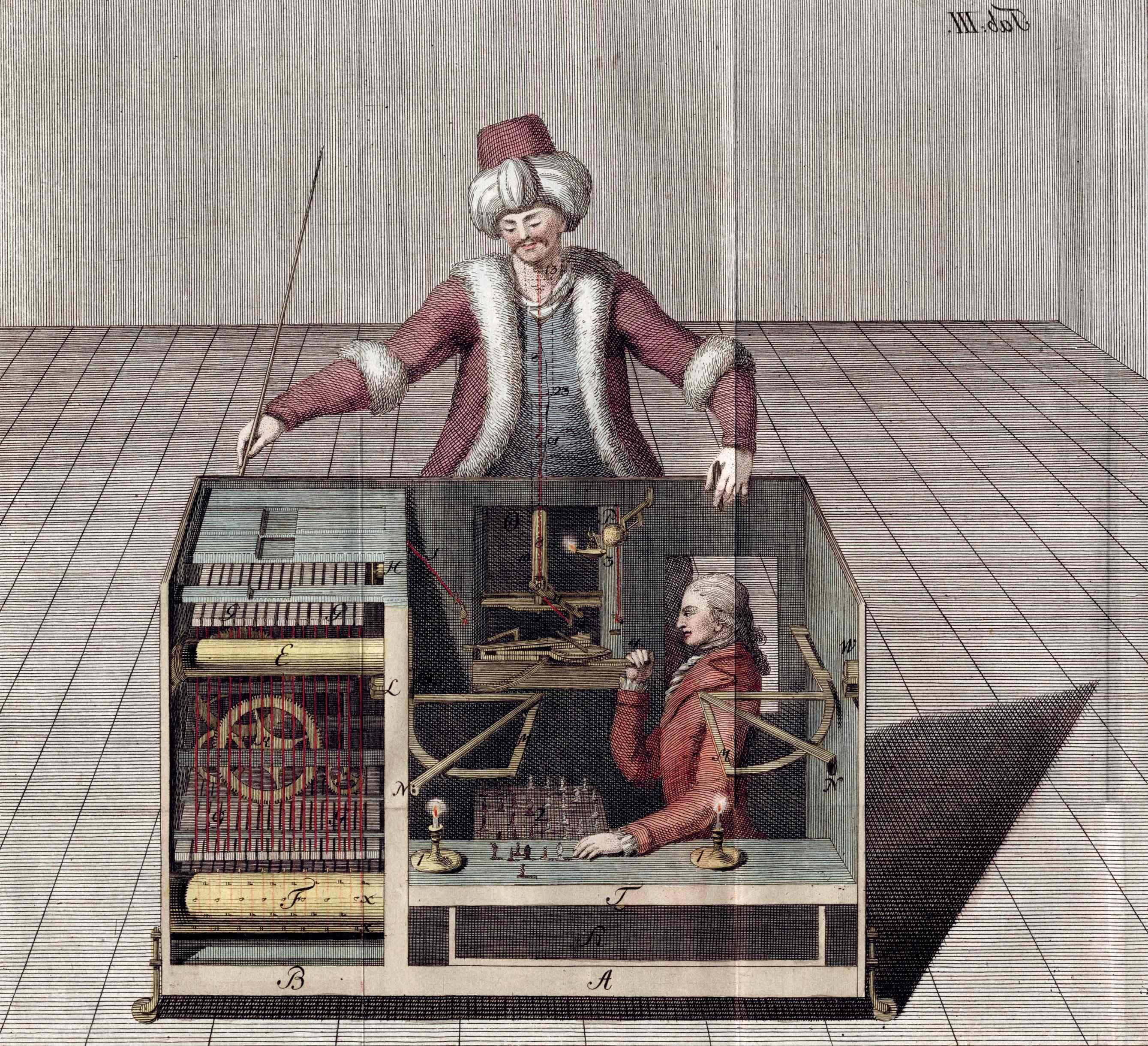
Since the Industrial Revolution, the relationship between man and his tools has become quite complicated. It used to be simpler. Tools were instruments that man would use to achieve his objectives. Now, certain workers have become tools that machines use to carry out theirs. For now, it is a sandwich: humans (CEO’s) using tools that use humans to achieve their objectives. Take the Amazon Fulfilment Center, for instance — a worthy boogeyman for a gen-alpha bedtime story. Fulfilment Centers are peak efficient machines, interlaced with human “nodes,” like the pickers who retrieve items from storage shelves after a customer order triggers a request on their handheld screen. A world full of machines necessitates a labor market that comes to the aid of the machine to supply its deficits– eyes, hands, feet, skills and accumulated experience. Amazon’s Mechanical Turk puts the idea on a postcard for us: a patent for a method in which a computer identifies which capabilities are needed to perform a task, and then assigns them to a human who has those capabilities. What is immediately distasteful about this patent is that it reverses the normal relationship between man and tools. Reading from the patent directly, “A hybrid machine/human computing arrangement including a central coordinating server and a number of human operated nodes, is provided to involve humans to assist a computer system to solve particular tasks, allowing the computer system to solve the tasks more efficiently” (Harinarayan et al.).
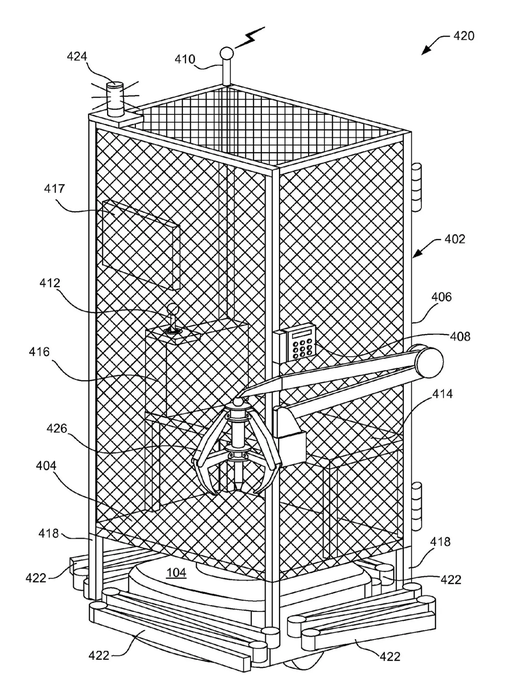
Above is an image of another Amazon patent, depicting a robotized metal cage that would carry a worker through the warehouse, if human intervention is needed in a primarily robot work area. What the 21st century. The purpose of the cage is to efficiently transport the human into the dangerous work area to complete its task, and get back again safely (Romano et al.). Together with Amazon, we are creating a world in which machine is primary and man is a secondary obstacle.
Automation is a particularly aggressive expansion of this phenomenon of man-second, machine-first. Teleoperation is its crown. A teleoperator is a person who remotely controls a robotic device — for example, teleoperators pilot robots through repetitive, real-world tasks using VR and motion capture to generate high-fidelity training data for AI models, with the end goal of automating these tasks through robotics. They are assisting confused Waymos and even controlling home robots to make morning coffee.
The way that the industry talks about teleoperation implies that the human presence in robotics is just the growing pains on the way to full automation. Waymo’s marketing positions the teleoperator side of its operation as “advice, not control,” “fleet response” not teleoperation, “phone a friend” not full driving. The function of this language is to keep the human role subordinate to the machine, regardless of how much the machine actually still needs it.
We ought not to buy the tale that teleoperation is just a short bridge to full automation. At the least it will be a very long bridge.
“Look at self-driving cars,” says Nvidia’s VP of AI research, Sanja Fidler. “In 2017 and 2016, I mean it felt tangible, right? It still took them quite a few years to really scale and even now, no one really scaled to the entire world, full autonomy. It's hard” (Ma). Waymo's predecessor project started in 2009. That’s roughly 17 years of “a few more years” and the fleet still runs on “advice not control” as a load-bearing safety mechanism. Rodney Brooks (iRobot co-founder) gives us a technical basis for skepticism of the bridge hypothesis: Robots learning dexterity from watching humans is “pure fantasy thinking” because human hands have roughly 17,000 specialized touch receptors, and unlike speech or image recognition — which had decades of existing data-capture infrastructure to build on — “we don't have such a tradition for touch data” (TechCrunch).
Teleoperators will be needed for long enough that it will be a career path for several more undergraduate degree cycles. Edge cases and confused robots will warrant the existence of “fleet response” workers, to use the language of Waymo. Teleoperation deserves our attention as those who are thinking carefully about the implications of the technological world we are creating. Two things will actually decide whether a teleoperator ends up with leverage or without it: where the work can physically be done from, and whether their judgment carries real authority or is just an input the system is free to overrule — like in the case of Amazon fulfillment. I will present four case studies of teleoperation, and we will attempt to answer the question, will a persistent teleoperation labor market result in a new flavor of misery-creating dystopian labor, where workers exist as the sense organs for a machine-first superstructure?
Case 1 — Meet Pie: Your Remote Cashier
Meet Pie. She is a 33-year-old remote worker — In New York City. Sorry, in the Philippines (Pohl). Well, both, really. Pie works for three restaurants, through an agency called Happy Cashier, and according to Pie, Pie is a happy, Happy Cashier. Pie appears in her restaurants through an iPad screen and a Zoom-like video feed, greeting customers and taking orders. Happy Cashier’s owner told Fortune “We pay 150% more than the average cashier job in the Philippines,” which gives us an estimate that she is making roughly $3 per hour, plus tips (Rey).
Why is Pie happy to make less than 20% of NYC minimum wage? Because in the Philippines, restaurant cashiers make $0.84 per hour on the low end, or $1.51 per hour on the high end. “I love the job,” Pie said with a smile. “Sometimes I even get good tips. One time, a customer in Jersey City gave me $40.”
Pie’s enthusiasm to make $3 per hour working a job that pays a NYC resident a minimum of $17 per hour makes me a little queasy. One imagines exploitative restaurant owners laughing all the way to the bank as they massively cut costs. NYC residents getting pushed out of the service industry because they can’t legally compete on price with the Pies of the world. A deepened divide between the north and south, where the south produces and the north consumes.
The dream case of teleoperation would be that over a long enough timespan, it leads to a democratization of physical presence.
If you have an EU passport then your opportunities to live, travel, work, earn money, and escape crises vastly outpace those of a Filipino passport holder. An EU passport holder can work visa-free in 30 countries: Switzerland, Germany, Norway, Iceland, to name a few. What about Filipino passport holders? Not a single country will let you work without a visa.
Teleoperation presents a vector to start squashing down these geographical opportunity gaps, and start closing the gap between Northwest and Southeast salaries. By leveraging VR and robot technology, where you do your work from could become less and less important. But history is a punishing teacher for this optimistic dream.
Remote platform work concentrates heavily in North America, Europe and South Asia (Braesemann et al.). The Global South’s participation in this type of work is marginal, and where it does exist, it exists for already urban, well-connected folks. Access to this kind of work is gated by network, which is gated by wealth and geography.
From the perspective of employers, remote work is a way to cut costs — GitLab publishes a location factor of 0.679, which means that, if you hire a global remote worker, the same role and same work product costs 68% of what it would cost if you hired someone living in San Francisco instead (GitLab). The relevant factor is not your skills or the quality of your work product. A worker is priced based on what an employer can get away with paying them, which is determined by where the available candidates live. The wage squeeze works in both directions: World Bank data shows that hiring more Indian workers pushes down U.S. wages by 2% (Brinatti et al.).
We can safely predict that teleoperation will follow a similar track: It will push down local wages and it will be priced based on how much money a worker needs to live rather than what their work is worth. Pie’s is the paradigmatic case of a job with no latency constraint at all — which is exactly why geography becomes a vector for exploitation rather than worker leverage. And yet we should listen to Pie when she says she is happy. Remote work can be a fantastic individual career opportunity while also perpetuating a nasty structure of production and consumption between the Global North and the Global South.
Case 2 — Waymo
When your Waymo gets stuck down a windy, one way street where a child is running after a dog that has stolen an old lady’s newspaper, more often than not, a teleoperator will be involved in safely resolving the situation.
Waymo runs four remote assistance facilities: two in the continental United States, two in the Philippines. You can't hail a Waymo in Manila, Philippines. Given the latency problem — that a human 150 milliseconds away is already almost too slow to help a car moving at speed — you shouldn't be able to assist one from there either, half a world and a Pacific-crossing cable away. And yet you can. What you can also do in the Philippines, if you are Waymo, is pay a highly skilled, English-speaking worker ₱20,000 a month. That’s $318. One would have guessed that latency pins this type of labor to a place, giving the worker leverage in wage negotiation. Perhaps not.
According to Waymo’s official technical disclosures, the median one-way latency — the time it takes for data to travel from the car to the operator's screen — is approximately 150 milliseconds for the domestic centers and 250 milliseconds for the centers in the Philippines (Bhuiyan). A car traveling at 35 mph covers roughly 13 feet in 250 milliseconds, making active remote steering at that latency incredibly dangerous. Instead, teleoperators provide assistance to the autonomous driving system, giving recommendations like, “go around it,” or “pull over.” We shouldn’t imagine teleoperators strapping up to VR headsets and playing GTA with a joystick steering wheel, either now or in the future.
The Waymo Event Response Team that manages responses to crashes or safety incidents can move a stopped Waymo — the single action (nudging a stalled car a few feet to clear a lane) that comes closest to actual “control.” This team is located exclusively in the U.S. (Bhuiyan).
35 of Waymo’s 70 fleet operators are operating in the Philippines (Bhuiyan). These workers are providing the kind of “go around it” or “pull over” advice to stuck Waymos mentioned above. Waymo makes it explicit that the car's software decides whether to accept or reject that advice; Waymo insists the agent never directly steers, brakes, or accelerates the vehicle.
In the case of Waymo, then, the American employees have an advantage. They are able to do the more serious event response work, which the Filipinos cannot. On the authority question, the American Waymo teleoperators win, too. The event response team gets the closest to actual control, while the Filipino workers are merely giving “suggestions” to the autonomous driving system, which has the final say. You’ll notice that I’ve been calling the Americans “employees” and the Filipinos “workers.” That’s because Waymo does not disclose whether the Philippines-based Fleet Response Agents are direct employees or contractors, nor has it identified any local partner company. When reporters from CleanTechnica checked public records from the Philippine Department of Trade and Industry, they found no registered Waymo entity or disclosed partner operations. Waymo is operating safety-relevant infrastructure through unnamed intermediaries in a jurisdiction with no visible corporate trace (CleanTechnica).
Case 3 — Neo 1X and Artisanal Mining
You wake up in Palo Alto, California — no, in Tamil Nadu, India. Roll out of bed, make coffee. Serve it up, drink it. You’re done. Now back to bed. Normal morning for normal people.
Except the coffee pourer and the coffee drinker are separated by 8,729 miles of mountain, forest, and ocean. These two people are tied together with submarine fiber optic cables and a globally interdependent economy.
Behold, the Neo 1X robot maid. You might have seen these in the news: the sweater-clad home robot, weighing in at 66lbs (light enough to knock over if it decides to run at you with a knife) with a lift capacity of 154 lbs and a carrying capacity of 55 lbs. These robots are selling like crazy. The Neo factory can produce up to 10,000 units per year, and the company claims they have over 10,000 orders already. Neo is valued at $10B — a tidy sum for a 2 year old startup.
The Neo home robot can’t do much, yet. It can just about walk around your home, pick up the odd sock, and hold a conversation with you. But if you want it to wake you up with your morning coffee — well, that’s gonna require “expert mode.” Enter, teleoperators. As part of the base price of $20,000, you can schedule for your robot to make your coffee or have a go at the dishes. A little light on the side of its head means there is a human teleoperator somewhere, remotely controlling the robot using joysticks and a VR headset.
On the consumer side, the dream of the Neo 1X is a nanny who will never rifle through your sock drawer, witness an awkward parenting moment, or judge your infatuation with overpriced bed technologies. A nanny who doesn’t sleep or take sick days, whom you pay for once. But in this in-between phase of market transformation, what the Palo Altans are getting is sometimes an autonomous robot and sometimes a remote-working human maid.
For our Palo Alto sleep-hacker whose Neo 1X is a great showpiece for parties, the person behind the camera eyes is just a part of the awkward friction of being an early adopter of a new technology.
If the job gets done, then you probably don’t care who did it — neural network or telehuman — or what challenges they faced along the way.
(Reyes)
But for our purposes, let’s think about the conditions of this Neo 1X teleoperator. “How long will it be until one of these virtual maids runs off with your kids as a hostage?” my friend asked. Not likely to happen. These robots are geofenced. They are not able to enter certain rooms, or leave the property.
Code is Law
This creates a weird kind of worker whose extended “body” is limited by hard powers: a new, human-made physics that prevents them from entering certain areas, or having the autonomy to choose not to steal/murder/indulge inappropriate curiosity.
The concept “code is law” was coined by cyberlaw expert Lawrence Lessig in his famous essay “Code Is Law” (Lessig). It is the idea that software rules and automated computer instructions act as a binding system of control. What a program allows or executes cannot be undone by human intervention.
The law of code is more like the laws of physics than the laws of a country. On Facebook, you can’t access a private group that you don’t belong to or read your neighbor's DM's anymore than you could jump and keep rising.
And the lawmaker, more often than not, is a private company. Take for example Altspace VR, a social VR platform that spent nearly a decade hosting the ordinary business of being human online — groups, friendships, weekly rituals — until Microsoft acquired Altspace and closed it as part of a layoff of 10,000 people. Code is law. Microsoft is the landlord, and you are evicted. 3 years later, the communities that used to live on Altspace were still hosting a memorial service for a piece of software (Reyes).
For the teleoperator robo-human maid, code is law, physically. 1X calls this arrangement a “social contract” — users must be “okay with” sharing data from their homes, in service of what the company brands a “big sister principle.” A contract implies two parties who can negotiate terms. A social contract, thinking with Rousseau, is one that is signed by the governing body, but not by the people subjected to the contract. 1X’s statement couldn’t be closer to the truth: The teleoperator never negotiates; the face of your employer is blurred out, the robot you are controlling is geofenced, and those rules that govern your work day were not negotiated with you.
Grant me that future where automation continues to need human intervention, even just for weird, edge case scenarios encountered by Neo 1X robots deployed in all sorts of formerly human domains — robo baristas, crane operators, drivers, fulfilment center prisoners, construction workers, doormen. There will be humans who spend their entire careers doing this work. Their physical body becomes more or less irrelevant to the proper performance of their work. Their physical strength, their location, the needs of their bodies, become totally secondary to the capacities, location, and needs of the robot body they teleoperate.
The current state of the Neo 1X home robot doesn’t manifest as a miracle for humanity — moreso a showpiece for Palo Alto flex-off parties. But the idea of the technology — a human shaped robot with human-type dexterity — offers all kinds of possibilities. Artisanal mining, for instance.
Artisanal Mining
In places where the Western imagination rarely rests, like the Democratic Republic of Congo, human beings are working in insane conditions to dig up tantalum — a vital metal for electronics (like capacitors in phones and laptops), aerospace engines, surgical tools, and medical implants. Miners dig narrow vertical shafts up to 100 feet deep using only basic tools like pickaxes and shovels, braced by tree branches. These shafts frequently collapse, killing everyone inside. An estimated 15,000 people die in artisanal mining operations per year — estimated, because mining companies don’t keep track of the figures.
Artisanal mining is a terrible way to get resources out of the earth. Mining tools not made out of flesh and blood could very well be used to source cobalt, for instance. The reason there are 40 million artisanal miners burrowing into the earth each year has more to do with unemployment, lack of options, and poverty than it does with efficient mining methodology. But tantalum is different. This incredibly important metal, which you have probably never heard of (I certainly hadn’t) is powering our world in the same way vibranium powers Wakanda, and it can’t be dug out of the ground with bucket wheel excavators. It is fragile, and exists in tiny pockets. This is where Neo 1X Robots could be deployed to safely extract this scarce resource: the tiny, 5 foot 6, 60-pound robot with similar dexterity to a human being. And when the 1X gets crushed in a flimsy mineshaft, there won’t be a funeral or mourning family members.
Offshore oil rigs, disaster response, firefighting — all of these incredibly dangerous career paths could potentially be offloaded to robots like the 1X. This kind of automation presents an attractive picture, on the face of it. Let humanity pass off the most dangerous jobs to robots controlled by teleoperators. This is possibly a win, but not a clear one. What happens to the artisanal miners who rely on this horrendous profession to make a living? In the best case, they will teleoperate the robots. In this case, they would have latency based leverage. When a mine caves in, you need low latency decision making. You also need the skills acquired by having been an artisanal miner. So these miners might get jobs in the Tantalum robot mining control center, for a bit, to train the robots, until the intricacies of their profession have been sufficiently harvested, and robotic technology becomes sufficiently advanced to shelve the majority of the humans, keeping a few of them on for “fleet response.”
Case 4 — Telesurgery: a fairly simple win
Events in New York City in September 2001 are remembered all across the world. But not typically this one: On the 7th of September, 2001, Professor Jacques Marescaux and his team removed the gall bladder of a patient in Strasbourg, France — from New York City (Marescaux et al.). This was the first successful remote surgery. A remarkable achievement, for medicine, robotics, internet technology, and Marescaux and his team. Early telesurgery tests in the ’80s, funded by NASA and DARPA, identified that latency above 500 milliseconds resulted in a very dangerous “move and wait” phenomenon, where a doctor would perform a cut, but due to the latency, would think they hadn’t cut deep enough, overcorrect, and cut too deep. It wasn’t until high speed fiber optic cables were developed that the latency could get down to 155 milliseconds, and become safe enough to perform operations.
As of 2026, SS Innovations, a major developer of the SSi Mantra surgical system, reported a total of 173 telesurgeries globally across its lifetime, 22 of those being highly complex cardiac telesurgeries (SS Innovations). It is by no means a mainstream medical method — yet. For now, specialist doctors fly all around the world to perform difficult operations. Take Dr. Diego González Rivas for example, a thoracic surgeon (the chest region between the neck and abdomen) who has performed surgeries in 136 countries, flying hundreds of times per year to complete over 10,000 lifetime surgeries (Diego Gonzalez Rivas Foundation). If telesurgery reaches a greater level of maturity, Dr. Rivas can stay at Shanghai Pulmonary Hospital where he heads up the thoracic video surgery program, and perform surgeries in ideal conditions — one day in Tanzania, the next in Kabul. Not to mention, Dr. Rivas could spend a whole lot more time with his family.
Conclusion
Teleoperation, then: Will it promote human flourishing, or will it be yet another 21st century technology added to the bucket of misery-creating, North/South-divide-perpetuating “advancements?” Given these four cases: (1) teleoperation doesn’t look that different from remote work. Particular individuals might earn double or triple their normal local wages while having little positive effect on the sum total of the North/South divide. (2) The relevance of latency to the particular case of teleoperation does seem to determine whether leverage lies on the side of the employer or employee. The simplest yes, to me, is that (3) teleoperation is a case study in machine-first thinking, where the skills of a human worker are deployed in service of the machine, rather than the machine’s capabilities being deployed for the benefit of the human. Although, for the Dr. Rivases of the world, who have extremely specialized and prized skills, it looks like the skills of the machines are subordinated. But for those without highly prized specialist skills, the basic facts of their human existence — eyesight, fine motor control, memory — are nothing more than “nodes” for the machine. The mechanical Turk expands.
Works Cited
Reyes, Julian. "As Virtual Worlds Close, Communities in 'Rec Room', Meta's 'Horizon Worlds', and Others Create Ways to Survive." Road to VR, 2026, www.roadtovr.com/as-virtual-worlds-close-communities-in-rec-room-metas-horizon-worlds-and-others-create-ways-to-survive/comment-page-1/.
Bhuiyan, Johana. "Waymo Says Its Robotaxis Get Help from Workers Overseas." GovTech, 2026, www.govtech.com/transportation/waymo-says-its-robotaxis-get-help-from-workers-overseas.
Braesemann, Fabian, et al. "The Global Polarisation of Remote Work." PLOS ONE, vol. 17, no. 10, 20 Oct. 2022, e0274630, doi.org/10.1371/journal.pone.0274630.
Brinatti, Agostina, et al. "The International Price of Remote Work." NBER Working Paper Series, no. 29437, National Bureau of Economic Research, Oct. 2021, revised Nov. 2022, www.nber.org/papers/w29437.
Tribdino, Raymond. "Waymo's Fully Autonomous Vehicles Have Fleet Response Agents in the Philippines." CleanTechnica, 6 Feb. 2026, cleantechnica.com/2026/02/06/waymos-fully-autonomous-vehicles-have-fleet-response-agents-in-the-philippines/.
Loizos, Connie. "Famed Roboticist Says Humanoid Robot Bubble Is Doomed to Burst." TechCrunch, 26 Sept. 2025, techcrunch.com/2025/09/26/famed-roboticist-says-humanoid-robot-bubble-is-doomed-to-burst.
GitLab. "Total Rewards: Compensation Calculator." GitLab Handbook, GitLab Inc., handbook.gitlab.com/handbook/total-rewards/compensation/compensation-calculator/.
Harinarayan, Venky, et al. Hybrid Machine/Human Computing Arrangement. US Patent 7,197,459 B1, 27 Mar. 2007.
Lessig, Lawrence. "Code Is Law: On Liberty in Cyberspace." Harvard Magazine, Jan.–Feb. 2000, www.harvardmagazine.com/2000/01/code-is-law-html.
Ma, Kylie. "The World Is Just Not Quite Ready for Humanoids Yet." TechCrunch, 10 Oct. 2025, techcrunch.com/2025/10/10/the-world-is-just-not-quite-ready-for-humanoids-yet/.
Marescaux, Jacques, et al. "Transatlantic Robot-Assisted Telesurgery." Nature, vol. 413, no. 6854, 27 Sept. 2001, pp. 379–380.
Pohl, Marie, and Steve Janoski. "This NYC Chicken Joint Employs Cashiers Zooming in from the Philippines — and Still Wants You to Tip!" New York Post, 9 Apr. 2024, nypost.com.
Rey, Roann. "This NYC Restaurant's Remote Filipino Cashier Sparked a Debate About Outsourcing." Remote Staff, 23 Apr. 2024, www.remotestaff.ph/blog/nyc-restaurants-remote-filipino-cashier-sparked-debate-about-outsourcing/.
Romano, Joseph, et al. System and Method for Transporting Personnel Within an Active Workspace. US Patent 9,280,157 B2, 8 Mar. 2016.
SS Innovations International, Inc. "SS Innovations Announces Completion of World's Longest-Distance Robotic Telesurgery." SEC EDGAR, 4 June 2026, www.sec.gov/Archives/edgar/data/1676163/000121390026065036/ea029288701ex99-1.htm.
"Telesurgery and New Robotic Surgery Training Curriculum." RoboticsTomorrow, 1 Sept. 2016, www.roboticstomorrow.com/article/2016/08/telesurgery-and-new-robotic-surgery-training-curriculum/8698/.
"The Diego Gonzalez Rivas Foundation Save Lives Thanks to Its Mobile Operating Room." Etkho, 19 Nov. 2025, www.etkho.com/en/the-diego-gonzalez-rivas-foundation-is-already-saving-lives-thanks-to-its-mobile-operating-room-and-etkho-is-actively-participating-in-this-mission/.