Economics
Raw Material: The Gary Plan and the Engineering of the American Child
The Gary Plan and the Engineering of the American Child
How does a building of fifty students in rural New Mexico differ from the colossi of 2,000 that inhabit every American suburb and city? This question is, I think, seldom asked — even though every American school used to look a lot closer to a New Mexican frontier building. Teachers were sourced locally and tended to be young unmarried women, the academic year spanned as few as twelve weeks, and schools integrated themselves into communities instead of retreating to become worlds unto themselves. Children read the Bible, Shakespeare, Greek and Latin, Roman histories, and foundational Anglo-American texts, participating in an older vision of education that sought to form the human person.
This model operated on the local level and, for the most part, was wise enough to recognize parents as the primary educators of children. It wasn’t perfect — fewer than 10% of Americans had completed high school in 1900. But far more disturbing is how this older model of education fell apart in the early twentieth century, and how the schooling that emerged in its wake quickly divorced itself from human formation. The story I’m about to tell is known to only a few, and it will be the goal of this essay to illuminate it to a greater number of people.
At the turn of the twentieth century, America was largely under the control of industry. Rockefeller, Carnegie, and Morgan are only the most striking incarnations of this spirit of unrestricted capitalism and efficiency that swept across America in the wake of its Civil War. Under the name of “scientific management,” this spirit insinuated itself within every institution, from the church and hospitals to social welfare and even the household. Home economics, urban planning, the research university, and productivity-as-a-science were born. Studies with titles like “Scientific Management in the Family,” “Home Efficiency,” and “Scientific Management in the Churches” were published, tainting institutions that had once only sought the formation of families and communities by forcing them to conform with the demands of the industrial age.
The manual for the efficiency experts was published in 1911 by Frederick Winslow Taylor, a mechanical engineer who made a name for himself at Midvale and Bethlehem Steel. His book, Principles of Scientific Management, is a guide for analyzing systems to improve their efficiency. “In the past,” Taylor writes, “the man has been first; in the future the system must be first.” Of course, Taylor believed that putting the industrial system first would improve the lives of people — at least, in material terms. But he does not seem to have been concerned with the moral or spiritual dimensions of people’s lives, and he goes on to advocate that workers be “scientifically selected and then trained” to carry out their jobs as efficiently as possible.
For workers to carry out their jobs in the industrial system as efficiently as possible, they would have to be dumbed down to a level of sophistication similar to that of their machines. Taylor writes, “one of the very first requirements for a man who is fit to handle pig-iron as a regular occupation is that he shall be so stupid and so phlegmatic that he more nearly resembles in his mental make-up the ox than any other type.” Education for the many would have to mirror the factory itself. Thus, I will call the model of schooling advocated by Taylor and the efficiency experts “factory schooling.”
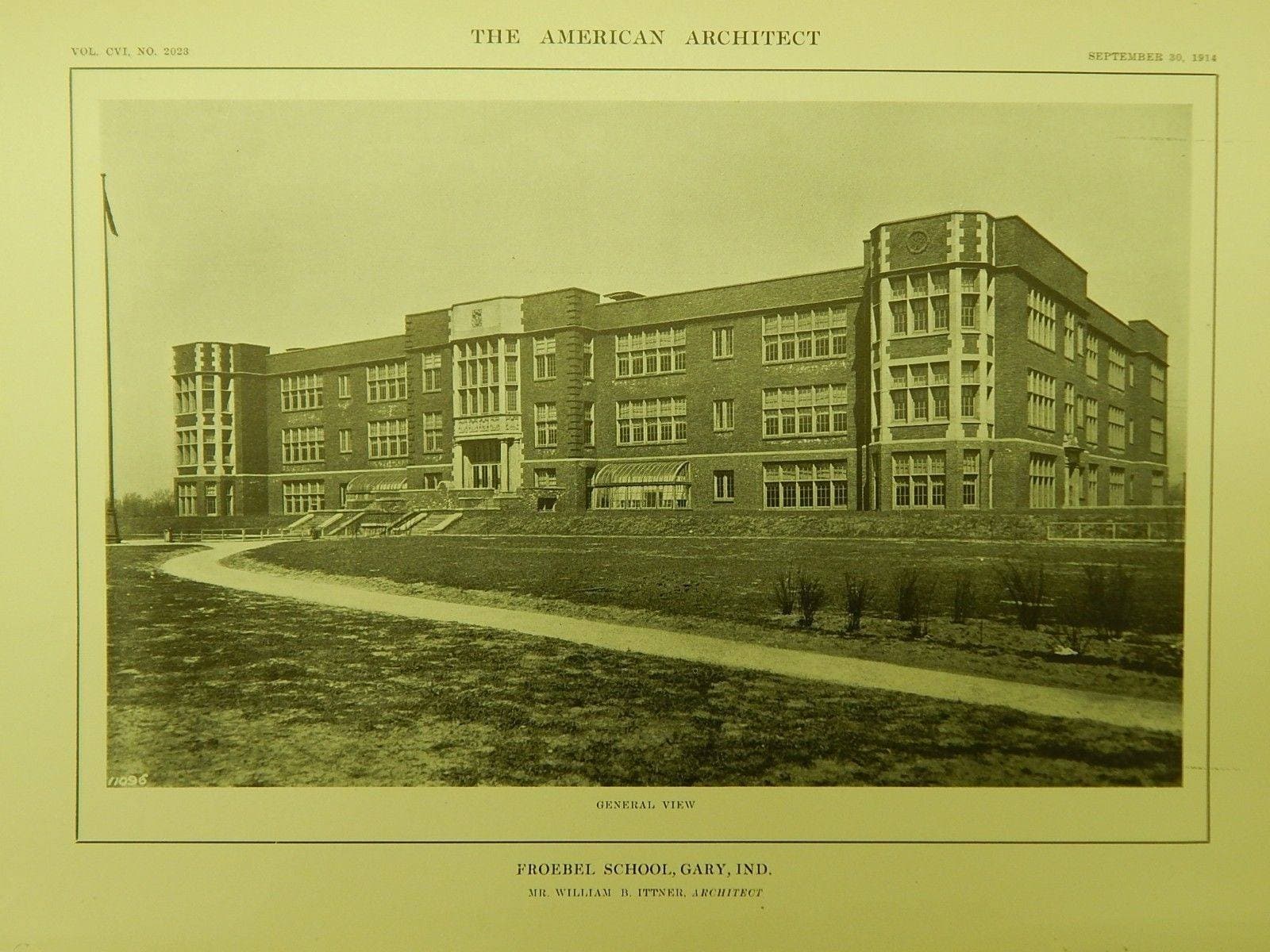
The story of factory schooling begins in a place one might not expect: Gary, Indiana. Today a deteriorated rust belt city, Gary was once a nexus point for the American steel industry. For decades, it was the sort of place where a Polish, Austrian, or Italian family seeking good wages might immigrate. In 1907, a schoolman named William Wirt became superintendent of Gary schools and began a more systematic approach to management. He lengthened the school day, enlarged buildings, implemented teacher hiring standards, and, most critically, began a work-study-play (also called “platoon”) system where students rotated between academics, recreation, and hands-on activities.
The platoon system was designed to mirror the factory system. Just as workers rotated between activity and rest, so too would students. Half would play in the morning and work in the afternoon; the other half would work in the morning and play in the afternoon. When they were studying, they would cycle between specialized teachers instead of spending the entire day with one or two. In theory, the platoon system would help students learn more through specialized teachers. But this practice carries risks — chief among them that children begin to disassociate the subjects from one another, rendering them incapable of comparing, say, mathematics and the classics.
In a 1911 article for the American School Board Journal, Wirt told his fellow schoolmasters that, using his platoon system, “the per capita cost for fuel, light, janitor service, and plant [by plant Wirt meant school] investment is practically reduced one half.” In this article and in others, Wirt always named financial savings before educational benefits. A contemporary of Wirt, education expert John Franklin Bobbitt, spoke similarly. In a 1912 article called “The Elimination of Waste in Education,” Bobbitt uses Wirt’s language of the school as a “plant,” and calls teachers “workers” and students “raw material”:
A first principle of scientific management is to use all the plant all the time. A second principle of scientific management is to reduce the number of workers to a minimum by keeping each at the maximum of his working efficiency. A third principle of efficient management is to eliminate waste. A fourth principle of general scientific management is: Work up the raw material into that finished product for which it is best adapted.
For Wirt, Bobbit, and others, society had to be formulated according to the logic and vocabulary of the industrial system. That meant reimagining the purpose, or ends, of schools, teachers, and students. Children were no longer ensouled human beings; they became commodities to be molded into the industrial engine. In 1913, the United States Commissioner of Education called the Gary Schools “a more practical form of industrial education” and “a fuller and more effective use of the time of the children.” A later report from the Bureau of Education also praised the idea of expanding the day into evenings, Saturdays, and the entire calendar year, since this would maximize plant efficiency and best prepare children for participation in the industrial system. It also lauded a Wirt initiative that relabeled the diploma a “work certificate,” calling the documents “a significant reminder to the graduates of the purpose of the school.”
Bobbitt concurred with the Bureau’s assessment, bemoaning the closure of schools on Saturdays and Sundays as a “thorn in the flesh of the clear-sighted educational engineer” while observing a “further loss of efficiency in the use of the plant by closing the building the two months of summer.” Harvard president Charles Eliot had a similar complaint in 1903 when he delivered a lecture to the National Education Association (NEA) entitled “The Full Utilization of a Public School Plant.” In it, Eliot observed, “It is obvious at a glance that so partial a use of an industrial plant would never be thought possible. No productive industry could be successfully carried on with so incomplete a use of an expensive plant.” Even America’s foremost academics had been captured by a system that imposed the language of the factory upon every aspect of life.
As the efficiency experts obtained control over education, old subjects waned. Ancient Greek and art classes were deemed too expensive when experts calculated the price-per-class. In a 1913 speech to the NEA, a Massachusetts superintendent named Frank Spaulding declared, “5.9 pupil-recitations [classes] in Greek are of the same value as 23.8 pupil-recitations in French … it takes 41.7 pupil-recitations in vocal music to equal the value of 13.9 pupil-recitations in art … the price must go down, or we shall invest in something else.” In other words, a student could attend 23.8 French classes for the same cost as 5.9 Greek lessons, and 41.7 music classes for 13.9 art classes. Traditional subjects had become too expensive to justify in an industrial era that looked purely at economic output.
By 1915, Wirt’s Gary schools were viewed as a national model. The New Republic magazine celebrated his “Gary Plan” as a leap forward in progressive education, while John and Evelyn Dewey’s book, Schools of To-morrow, endorsed the plan, stating, “In discipline, in social life, and in the curriculum the Gary schools are doing everything possible, in coöperation with church and home, to use to the best educational purpose every resource of money, organization and neighborhood influence. The school is a small community … and a democratic one.” The Deweys’ description of Gary schools as “democratic” may sound puzzling to our ears, but they were really quite egalitarian. Every child was being prepared for the working life by teachers who were workers themselves — one equal collective moving with the industrial engine.
That September, Wirt was hired by New York City at $10,000 (over $300,000 today) per year to carry out the “Garyization” of their schools. A consortium of Rockefeller-linked educational organizations, municipal officials, and progressive reformers had facilitated Wirt’s appointment, seeking the rapid transformation of New York City schools according to his platoon model. By the new year, the Gary Plan was being implemented in select city schools. But controversy soon emerged.
In April of 1916, the City Superintendent of Schools, William Maxwell, recommended the full discontinuing of the Gary experiment in New York City, calling the plan a budget-cutting measure that came at the expense of academic progress. Nevertheless, between 1916 and 1917, the plan continued under Wirt’s supervision as a pilot program, and in September of 1917, the Board of Education requested $5,000,000 to carry out the total Garyization of the district.
As factory schooling loomed over the 1917–18 academic year, many New Yorkers balked at the experiment, which had the backing of John Purroy Mitchel, the young and progressive city mayor who was up for reelection in November. The Gary Plan became a focal point in the election, with Mitchel’s opponent, John Hylan, castigating “a system which is called the Gary system, the result of which has been to greatly reduce fundamental education and place an added physical strain upon the child” by seeking workers “trained for the shop and factory, instead of for higher professions.” Under a Hylan administration, he promised, “our boys and girls shall have an opportunity to become doctors, lawyers, clergymen, musicians, artists, orators, poets or men of letters, notwithstanding the views of the Rockefeller Board of Education.”
That fall, activists spoke out against the Gary Plan on street corners, truancy was common, and there were multi-day demonstrations. On October 16th, crowds of predominantly Jewish Eastern European families — many having believed that America was an escape from collectivism — went into riot, leading to this New York Times headline the next day: “1,000 PUPILS IN RIOT AGAINST GARY PLAN; Smash 100 Windows in Upper East Side School and Scores Are Arrested. AGITATORS URGE THEM ON.” Three weeks later, Hylan won the mayorship in a landslide, and after his swearing in, he removed Gary officials like Wirt from city leadership. However, budget concerns meant that many key elements of the Gary Plan remained, and in December the New York Times ran this headline: “Hylan May Permit Gary Plan to Stay.”
In 1918, Rockefeller’s General Education Board published an eight-volume study called The Gary Schools: A General Account, directed by Abraham Flexner — another leader in the progressive education movement. In the study, Flexner concluded that “the Gary experiment has not yet successfully solved the problems involved in the attempt” while nevertheless praising its “large and generous conception of public education.” Thus, even the Rockefeller audit of the Gary schools took issue with their implementation. Flexner would later write that the experiment had been “advertised on the basis of inadequate supervision and without definite accounting.” Of course, a cynical observer could have argued that mediocre education was the whole point.
Flexner’s report infuriated Wirt, but it did not halt the success of his experiment, ushered in by a decade of explosive population growth and urbanization. Wirt returned to Gary as Superintendent of Schools, and his model swept across cities like Detroit, Pittsburgh, Chicago, Kansas City, and Los Angeles. By 1929, Gary schools could be found in 1,068 schools across 202 cities. However, Wirt later became disillusioned with the increasing centralization of the American economy, leading to a rift between him and other progressive leaders. In 1933, he became enraged at a private dinner with members of the Roosevelt administration, whom he would accuse of deliberately prolonging the Great Depression. “I was told,” Wirt writes, “that they believed that by thwarting our then-evident recovery they would be able to prolong the country’s destitution until they had demonstrated to the American people that the Government must operate industry and commerce.” He further accused members of the administration of seeking “a planned economy, wherein the every day activity of the people would be regimented and controlled by the government, functioning through bureaus.”
Wirt apparently did not realize that it was he who had built the factory schools so integral to that deplorable planned economy. He was perhaps the man most responsible for the generation of factory workers that so obediently followed the direction of Roosevelt’s civil and industrial initiatives. Of his Gary Plan, one Detroit mother who subsequently pulled her son out of school observes: “[The school] looked to me like nothing so much as the lines of uncompleted Ford cars in the factory, moving always on, with a screw put in or a burr tightened as they pass — standardized, mechanical, pitiful.” Another account from teacher Margaret Haley describes children “rotating from room to room, teacher to teacher … Even the six-year-old children have six or seven teachers a day, and as many as twelve or thirteen in some cities. Teachers handle as many as four hundred different pupils a day, and a thousand in a week.”
Although some elements of the Gary plan fell out of practice, the essentials remained after Wirt’s death in 1938: eight hour days, towering buildings, evening classes, teacher credentials, six classes per day, rotations between work and leisure. Schooling, in essence, became an image of the industrial system. Teachers were expected to cycle between hundreds of students per week, rendering them indistinguishable from factory workers and their students indistinguishable from raw material to be worked and molded into a finished product.
What, then, are we to make of factory schooling today? Doubtless it has become anachronistic — America is no longer a broadly industrial nation, and it has not been so for some time. As this reality has become more obvious and as academic standards have fallen since the mid-twentieth century, modern versions of the Gary Plan have been attempted. Today, new factory schools are sprouting up everywhere centered on digitalization and AI. Whereas in Wirt’s time, children learned from a teacher acting like a machine, today they learn directly from the machine, enlivened by the computer revolution that began in the 1970s.
By learning from iPads, AI models, and televisions instead of from other humans, young people start to resemble these machines. I’ve seen it happen far too often: children who should be living out the joys of youth hypnotized by technology so powerful, scant few offer any resistance. Soon whatever is on the screen is all they are talking about, and you wonder what it would take for them to recover their own humanity. People who advocate bringing children closer to the machine claim that our economic circumstance requires such radical change — and that actualizing this change demands that every five-year-old learn from an iPad and a Google Gemini subscription. Only then, they say, will he or she know how to participate in the AI-powered future that day-after-day rises more ominously on the horizon.
The new factory schools are, of course, a bad idea for the same reasons that the old ones were: They place the system over the human person. By prioritizing economic “needs” instead of human ones, old sources of wisdom, morality, and knowledge are lost. Just as the early twentieth century efficiency experts killed Greek and Latin instruction in public schools, so too are the modern experts killing books and even literacy itself in many schools. Literacy, of course, will not be strictly necessary in a world where AI is responsible for most economic output. In this future where humanity gives itself up to AI, books will at best become more old-fashioned than they already are, while at worst, they will be forgotten — nothing more than the raw material used to train the next LLM.
The antidote to the factory schools is obvious enough; it consists in forming the whole person by teaching children about their civilizational inheritance through what is now called classical education, but what the nineteenth century simply called “education.” Over the last few years, the educational winds have certainly been blowing in the classical direction, but it is not enough to meet the moment. We need more people who will expound the joy of learning for its own sake. We need to form more leaders who can fight against factory schooling and build a humanistic education to replace it. And finally, to expound the boundless wonder of contemplating the human body, soul, and story, I turn to Shakespeare’s Hamlet:
What a piece of work is a man! how noble in reason! how infinite in faculty! in form and moving how express and admirable! in action how like an angel! in apprehension how like a god!
Works Cited
Primary Sources
Bobbitt, John Franklin. "The Elimination of Waste in Education." The Elementary School Journal 12, no. 6 (February 1912): 259–271.
Bourne, Randolph S. The Gary Schools. Boston: Houghton Mifflin, 1916.
Burris, William Paxton. The Public School System of Gary, Indiana. Bulletin 1914, No. 18 (Whole No. 591). Washington, DC: U.S. Bureau of Education, 1914.
Commonwealth of Massachusetts. An Act Concerning the Attendance of Children at School (Massachusetts School Attendance Act of 1852). Acts and Resolves Passed by the General Court of Massachusetts, 1852, ch. 240.
Dewey, John, and Evelyn Dewey. Schools of To-morrow. New York: E. P. Dutton, 1915.
Eliot, Charles W. "The Full Utilization of a Public School Plant." Address to the NEA Department of Superintendence, 1903. In Journal of Proceedings and Addresses of the National Educational Association, 1903.
Flexner, Abraham, and Frank P. Bachman. The Gary Schools: A General Account. New York: General Education Board, 1918.
Taylor, Frederick Winslow. The Principles of Scientific Management. New York: Harper & Brothers, 1911.
U.S. Congress, House. Investigation of Certain Statements Made by One Dr. William A. Wirt. House Report No. 1439, 73rd Cong., 2nd Sess. Washington, DC: Government Printing Office, 1934.
Wirt, William A. "Scientific Management of School Plants." American School Board Journal 42 (February 1911).
New York Times. "1,000 Pupils in Riot Against Gary Plan; Smash 100 Windows in Upper East Side School and Scores Are Arrested." October 17, 1917.
New York Times. "Hylan May Permit Gary Plan to Stay." December 1917.
Shakespeare, William. Hamlet.
Secondary Sources
Bleiberg, James S. The Reform Movement and the Jewish Community of New York City, 1898–1932. Ph.D. diss., Hebrew Union College–Jewish Institute of Religion, 1982.
Callahan, Raymond E. Education and the Cult of Efficiency. Chicago: University of Chicago Press, 1962.
Cohen, Ronald D., and Raymond A. Mohl. The Paradox of Progressive Education: The Gary Plan and Urban Schooling. Port Washington, NY: Kennikat Press, 1979.
Gatto, John Taylor. The Underground History of American Education. New York: Oxford Village Press, 2000.
Ravitch, Diane. The Great School Wars: New York City, 1805–1973. New York: Basic Books, 1974.
Strouse, Jean. Morgan: American Financier. New York: Random House, 1999.