Technology
Intelligent Artifice
What the Myth of the First Robot Reveals About Technology and Politics
Are myths easy to understand? They can seem to be, since they give us images before they give us arguments. The ancient Greek myth of Talos, the bronze giant who guarded the Mediterranean island of Crete, is commonly understood to be about the first robot. Classical historian Adrienne Mayor, in her 2018 book Gods and Robots: Myths, Machines, and Ancient Dreams of Technology and in popular pieces based on her work, has done more than anyone to make Talos accessible to contemporary culture. Her success can be seen in the way discussions of Talos tend to pass through her account, which gathers the remaining literary and visual sources into a single figure. Mayor presents Greek myths as ancient thought experiments with living implications for science, technology, politics, and warfare, especially for the dangers of making beings or systems on which we depend without fully understanding them.
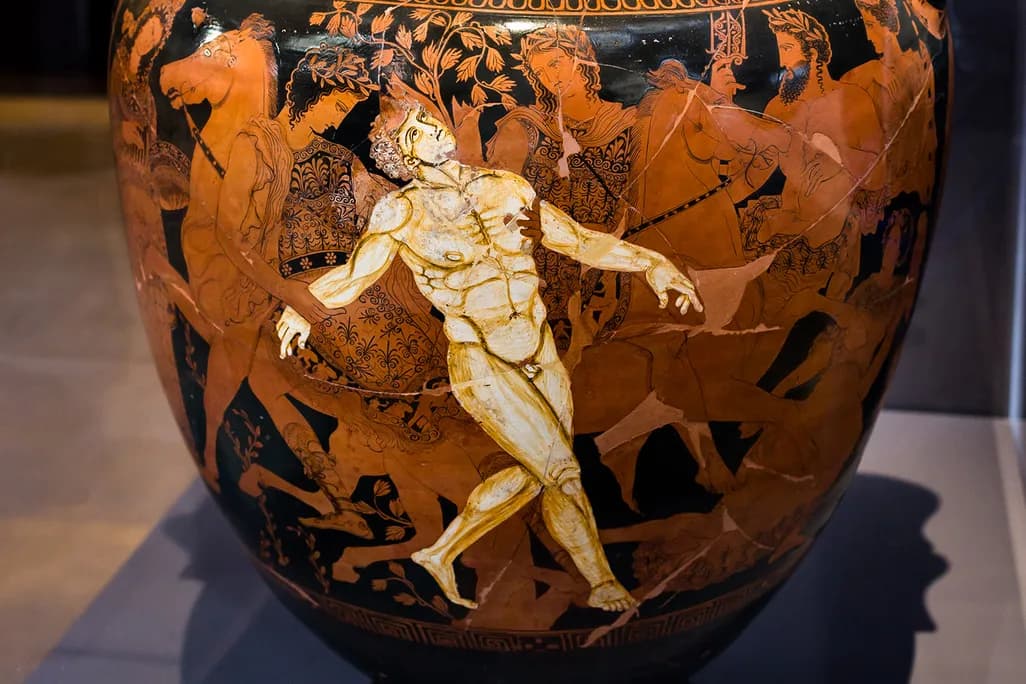
This reading is valuable because it shows that ancient myths were already exploring problems we associate with modern technology. In Mayor’s account, Talos is made by Hephaestus, the god of craftsmen, as a gift for Minos, the king of Crete. He is tireless and superhuman. He circles the island three times a day and repels strangers by pelting them with boulders. Yet he has a hidden vulnerability: a vein exposed at his ankle containing ichor, the divine blood that gives him life. When the Argonauts arrive at Crete after completing their quest for the Golden Fleece, Talos prevents them from landing. Medea, the princess of Colchis and sorceress descended from the Sun, must defeat him so the Argonauts can come ashore. In the version emphasized by Mayor, Medea exploits Talos’ desire for immortality, distracting him with incantations while Jason, her husband and leader of the Argonauts, opens the vein and kills him.
Medea’s victory can look like an ancient image of hacking: A foreign agent discovers the hidden weakness of a state’s apparently invulnerable security system. Put this way, the myth immediately feels contemporary. Talos guards a perimeter. He is automated and stronger than human defenders. Yet he depends on a hidden internal mechanism. He falls when an enemy discovers how to exploit that mechanism. It is easy to understand why Talos now appears as a symbol of robotics, artificial intelligence, automated defense systems, and cybersecurity. The myth seems to anticipate technologies that would not exist for millennia and the dangers that emerge when the things we create exceed our control.
* * *
But how should we understand this argument? Mayor makes a composite Talos suited to modern questions about machines, consciousness, programming, and control. These are genuine questions, and Mayor is right to see that myths can speak to them. But they are not necessarily the questions asked by the ancient sources. After all, to call Talos the first “robot” is already to interpret him within a modern horizon: The word robot comes from the Czech robota, “forced labor.” The modern robot carries the connotation of a slave that may imitate, deceive, or overthrow its master.
The ancient evidence may be stranger than that frame implies. Talos can be understood as a cluster of related images. In different sources he is a bronze man made by Hephaestus, the last survivor of the bronze race preserved by Zeus, a bull, or a winged being. In some sources he is given to Minos; in others, to Minos’ mother Europa after Zeus abducts her in the form of a bull. In one source he attacks approaching ships with rocks, while another imagines him embracing enemies and burning them with his heated body. Medea always defeats him, though the manner of defeat varies with the sources: trickery, enchantment, a wound, or the draining of ichor.
These variations show that the myth of Talos cannot be exhausted by the idea of the first robot. It gathers together questions of technology, guardianship, law, violence, vulnerability, and political order. But if we begin from contemporary questions around topics like artificial intelligence, the ancient questions may either get flattened into one modern interpretation or scattered into antiquarian curiosities.
* * *
Where, then, should we begin? Perhaps with what remains constant across the sources: his work and his defeat. Talos lives to guard Crete, yet he dies at the hands of Medea. Whatever else he is, he is primarily the guardian of a political order that cannot withstand foreign intelligence. Across the sources, the fact that he may be man, machine, bull, or winged matters less than the work he performs. Whatever the method of defeat, Medea’s victory raises the deeper question of whether Talos can fulfill the purpose behind his work.
The richest sources for Talos are therefore more than evidence for the origins of science fiction. They are among the earliest and clearest reflections on the moment when law and order are entrusted to a guardian who can preserve what he does not understand and whose own preservation depends on hidden vulnerabilities. Two sources are especially rich: Apollonius’ Argonautica gives us the poetic image of Talos to interpret, while Plato’s Minos gives us the philosophical problem through which Talos becomes intelligible. Read together, they suggest that Talos is an image of politics becoming technological: constant, insular, inherited, and vulnerable.
* * *
Apollonius lets us see Talos as an image through which an argument emerges. In the Argonautica, Talos appears as a technological problem the Argonauts meet at the edge of a political community. Near the end of the poem, the heroes come to Crete exhausted and thirsty. They are not conquerors, yet Crete is guarded by Talos, who breaks rocks from the cliff and hurls them at the ship, preventing the heroes from fastening their hawsers to shore. Apollonius then gives a brief genealogy of the guardian: Talos is the last survivor of the bronze race, descended from men sprung from ash trees. Zeus gave him to Europa to guard Crete by circling the island three times each day (Arg. 4.1638-1644).
Apollonius presents Talos as both artificial and ancestral. He may be metallic, but he is inherited from a superhuman past that belongs as much to mythic nature as to divine craft. His origin alludes to the old violence of Hesiod’s bronze race, whose members destroyed themselves through conflict. The Cretans do not appear to have chosen or built him, or deliberated about his function.
Europa matters here because she is absent. Talos was given to her, but she is not there when he falls, nor is her son Minos, the founder of Crete. Theseus, the slayer of the Minotaur with the help of Minos’ daughter Ariadne, is long since dead. The one to whom the guardian was given has withdrawn with the god who wronged her into myth. Talos’ origin is known only through poetry. What remains in Crete is knowledge of his operation: His being is the repetition of his task.
Talos is a survivor of the past whose power has become automatic. This paradoxically makes him a truer image of technology than if he were simply made by Hephaestus. Technology may seem to liberate us from the past toward progress, yet it often preserves inherited values and assumptions into the future. Every community inherits basic inventions: language, law, and institutions. Over time these inventions stop feeling invented. They become the constant conditions under which life is possible. The original inventors can be forgotten without the assumptions embodied in their inventions ceasing to order our existence. Crete’s order has become inseparable from Talos’ constant circling.
That circling is apparently the only thing he does. He goes around Crete three times each day. If taken literally, the detail suggests a patrol far beyond human capacity. Crete’s coastline is roughly 650 miles. Even if Talos had the whole day to complete three circuits, each one could take no more than eight hours. He would have to move above eighty miles per hour, and faster still if the circuits were separated by intervals of rest. Apollonius is imagining inhuman surveillance and defense in a human shape.
Talos protects by repetition rather than judgment. He does not distinguish supplication from invasion or friend from foe. He sees strangers approaching and answers with force. A guardian is necessary because a political community cannot survive if every boundary must be reinvented at every moment. Defense requires regularity. It must be more durable than fear or desire. A community without stable protection is subject to chance and the will of the stronger. In this limited sense, something like Talos is necessary for political life: a durable form of protection.
But the very regularity that makes Talos useful also reveals his limit. The same boundary may protect a community from destruction or harden it against legitimate exchange. Automated guardianship promises to remove the weaknesses of human rule. It replaces the bribable guard and lets citizens sleep. But the more perfectly artifice guards us, the more tempting it becomes to confuse guardianship with intelligence. Talos can preserve Crete, but he cannot know what Crete is for.
Apollonius makes this ambiguity visible in the images he chooses. When Talos breaks off rocks and hurls them at the Argo, he recalls the Cyclops hurling stones at Odysseus’ ship in the Odyssey. His vulnerable ankle also anticipates later traditions about Achilles’ heel. He is monstrous and heroic at once. His nobility and brutality cannot be cleanly separated because both come from the same function. He is faithful to Crete, but fidelity without judgment can become a pretext for violence.
* * *
Talos’ power is undeniable; the next question is whether it can escape the conditions that govern all mortal things. The Argonauts cannot defeat Talos by ordinary means. Their arms are inadequate before the bronze giant. The age of Talos is not the age in which glory is won by meeting strength with strength. A certain kind of knowledge is needed. So Medea intervenes. She says she can subdue him unless his life, too, is everlasting.
Apollonius tells us that Talos’ body and limbs were bronze and unbreakable, but that beneath the sinew by his ankle there was a blood-red vein. Over it, a thin skin held the bounds of life and death (Arg. 4.1645-1648). This is the secret of artificial power: It looks invulnerable because its dependency is hidden, just as its origin has been forgotten. Talos has ichor running through a vein exposed at the ankle. Our systems have power sources, supply chains, code, maintenance labor, and points of trust.
If Talos were truly immortal, Medea could not defeat him. If technology could become entirely self-sustaining, it would cease to be merely a human instrument. But Talos is not a god. He is a made or born thing. Like all such things, he is mortal.
Medea matters because she introduces a second kind of artifice. Her sorcery is a form of technē set against Talos’ technē. The Greek word technē means art, craft, skill, or know-how. It is broader and older than our derivative word technology. In the context of the Talos myth, it is best understood as intelligent artifice: the capacity to bring intelligence to bear on what nature does not simply provide. It can name the art of the physician, poet, statesman — or sorceress. Talos’ patrol is technē hardened into a public system. Medea’s sorcery is technē retained as private cunning.
Talos is dangerous because his artifice has been severed from judgment. Medea is dangerous because her intelligence has been severed from law. Between them, Apollonius makes visible the central problem of technē: Intelligent artifice can preserve a city or destroy it.
Apollonius makes Medea’s danger palpable. She veils herself and Jason helps her mount the deck. She invokes death-spirits, hardens her will with malice, and fixes Talos with an alien gaze (Arg. 4.1661-1672). If her attack is the evil eye, the veil controls her aim. Her magic is distant harm, trained on the bronze guardian to make him yield. Her witchcraft is intelligent artifice, but inhuman and dangerous.
At this point, Apollonius interrupts the action. He invokes Father Zeus and marvels that destruction comes not only through diseases and blows, but that someone may torment us even from afar (Arg. 4.1673-1675). The apostrophe to Zeus matters because Zeus was the giver of Talos to the Cretans. The god who gave the guardian is invoked at the moment when the guardian proves vulnerable. The apparently divine gift of technological protection is undone by another kind of human power: one that reaches Talos through the conditions of his existence.
The result is not quite hacking in the modern sense, since Apollonius’ Medea does not appear to know about the ankle in advance. But it is close enough to be unsettling. Medea brings down a system by making its own structure betray it. Talos stumbles while hexed and wounds his ankle. Technology falls because someone can act upon the point where it is exposed even without knowing exactly where that point lies. The artificial may become intelligent, or it may not; the more pressing issue is whether artifice is governed intelligently rather than depended upon blindly. If it is not, there is always the possibility of a Medea who can destroy it.
* * *
Talos is still heaving rocks at the Argonauts when Medea makes him graze his ankle on a pointed crag. The ichor gushes out of the vein like melted lead. For a while he remains standing on his tireless feet. Then Apollonius compares him to a great pine left half-hewn by woodmen. It shivers in the night wind and then snaps at the stump, crashing down (Arg. 4.1676-1688).
Talos is bronze, but he falls like a tree. The simile returns him to the natural world he seemed to transcend and to his Bronze Age origin among men sprung from ash trees. The bronze man yields to spells as pine trees yield to axes. Artifice and nature are inseparable at the moment of collapse. Even the image of ichor flowing like melted lead suggests that his divine blood is also his mortal origin.
But Apollonius refuses a simple liberation from the machine. The Argonauts sleep that night in Crete. At dawn they build a shrine to Athena, the goddess of wisdom, draw water, and depart (Arg. 4.1689-1693). Somehow, they encounter no other people on the island. The absence may simply mean that they landed on a deserted coast rather than near the cities inland. But Apollonius’ silence about the Cretans is suggestive. Crete has depended on Talos so long that its citizens seem to have disappeared.
Talos defends the island by simply keeping strangers out. But the poem makes us wonder what becomes of a people whose safety is so fully entrusted to such a guardian. Their community seems strangely absent from the order Talos preserves.
Nor are the Argonauts simply free because Talos falls. Almost immediately after leaving Crete, they are swallowed by Darkness and must be rescued by Apollo’s revelation of another island: Anaphe, whose name Apollonius connects with Apollo’s making the island appear (Arg. 4.1694-1730). The elimination of technology would not end human dependence. It only passes us from one source of survival or meaning to another. The Cretans depend on Talos to defend them from the foreign. The Argonauts depend on their ship, Medea, and the gods to help them reach their goals. Human life cannot be understood as purely natural or purely conventional. Our biology is always entangled with technē and may even need to express itself through technē. The final question is whether human beings can control the forms of technē by which they live, or whether technē will come to control them.
* * *
Plato’s Minos makes explicit what Apollonius leaves implicit. If the Argonautica shows Talos at the shore as a guardian embodying technological power, the Minos shows how that guardian also embodies law. The Minos gives a much briefer version of the myth. Here Talos is a human officer who goes through the villages of Crete three times a year carrying Minos’ laws written on bronze tablets (Minos 320c).
For a modern reader, this can seem like a deflation of the myth: Perhaps the imaginary first robot was just an official with tablets after all. But this version clarifies the myth’s meaning. In both versions, Talos preserves Crete through bronze, circulation, and guardianship. Political order is preserved by a figure whose task is to maintain the structures through which the community understands itself.
The Minos helps us understand why Talos is more than a technological guardian. He is what law looks like when it depends on an artificial medium to outlast speech and habit. Bronze preserves the law after the lawgiver dies. Circulation carries the law beyond the immediate context of command. Repetition makes the law appear settled. In both versions, Talos is the mechanism by which a political order tries to maintain itself.
* * *
But what defines a political order? The Minos begins by asking what law is “for us” or “among us.” The first answer is that law is the city’s accepted opinion or decree. That answer seems plausible because most of what we call law appears as what a city has voted for or enforced. But a city can accept shameful things. Its official opinions can be false or unjust. If law were simply whatever a city happens to accept, there would be no way to distinguish law from error. The dialogue therefore presses to the astonishing claim that law “wishes to be the discovery of what is” (Minos 315a).
This sentence is central to the dialogue. Law is not identical with wisdom, since human beings often make bad laws and change them. But law is also not reducible to control. It points beyond persuasion or compulsion toward truth. A law claims that something should be so because something else is the case, not merely because someone wants it so. It aspires to make an order that corresponds to what order itself truly is. That aspiration is what makes law noble. But it is also what makes it dangerous.
Talos is a precise example of that danger. If law were fulfilled by inscription, circulation, antiquity, and force, Talos would be enough. The bronze tablets would need only to travel. But if law wishes to be the discovery of what is, then Talos is insufficient. He can preserve the surface of law, but not reach its ground. He can enforce a rule, but he cannot know how or why it should be enforced in every circumstance.
Socrates’ nameless companion raises that very objection: Human beings do not use the same laws everywhere or at all times. Laws change from city to city and generation to generation. If law wishes to be the discovery of what is, why is it so variable in ways that seem to ignore what is? Socrates answers by analogy to the arts. Doctors, farmers, musicians, trainers, shepherds, and kings know how to distribute what is fitting to the beings entrusted to them. The true lawgiver would know what is fitting for human souls. This suggests what law would have to be grounded in if it were truly law, though it does not suggest that any given city’s laws have achieved it.
The dialogue therefore reveals a gap between law’s aspiration and appearance. Law wishes to discover what is, but law appears as custom and enforcement. It wants to be more than opinion, but unless there is a wise lawgiver, it must become present in the city through fixed norms that do not require wisdom to be obeyed. Talos embodies that gap. He is what remains when the lawgiver’s act survives after the lawgiver’s wisdom has disappeared. He is law’s aspiration to become durable and self-enforcing when knowledge of what law serves remains uncertain.
* * *
Socrates ends by asking what the good lawgiver and pasturer distributes to the body to make it better. The answer is easy: food and toil. Food makes the body grow; toil exercises and strengthens it. But when Socrates asks what the good lawgiver distributes to the soul, the companion cannot answer. Socrates calls this shameful: They have investigated the body and the rest, but remain ignorant about the things in the soul in which good and base inhere (Minos 321c-d).
The dialogue deepens this problem through the image of distribution. Different arts distribute different things rightly: seed to soil, notes to music, food and toil to the body. The political art must know what is fitting for the soul. This makes law more than administration or enforcement. It is concerned with the formation of human beings. To be human in the fullest sense is not simply to have a human body or belong to a city. It is to have a soul ordered toward the good. Talos, whether bronze giant or human courier, belongs to the machinery of distribution and maintenance, not to the knowledge of what should be distributed or maintained.
The analogies in the Minos are unsettling because they reveal that rule requires unequal knowledge of ends. A shepherd knows where the sheep should graze in a way the sheep do not. A physician knows what restores health in a way the patient may not. Rule differs from being ruled because it requires some understanding of what is fitting. The one who rules must know not only how to preserve bodies, but what preservation is for.
But this distinction between command and knowledge does not vindicate tyranny. It sharpens the problem of law. If law is only command, the ruler is merely stronger. If law is knowledge, the ruler must know something about the good of the ruled. The difficulty is that most human beings live under laws and customs they did not make and cannot fully explain. They are formed by an order before they can judge it. The question then is whether that formation prepares them to become capable of judgment or only habituates them to obedience.
In response to this difficulty, Socrates seems to praise Minos’ laws. They are ancient, stable, divine in origin, and still in use. Their durability seems to testify to their goodness. Yet durability is not the same as truth. The dialogue shifts from law as discovery to the signs by which a human community recognizes authoritative law: age, divine sanction, and preservation.
Talos is introduced after this shift in the dialogue. He guards the laws by carrying them on bronze tablets through Crete. He does not demonstrate their truth, but he preserves their continuity. The nameless companion’s skepticism returns because of Minos’ bad reputation among Athenians like himself and Socrates. In the Athenian imagination, Minos is remembered for tyrannical acts, above all the demand that Athens send its youths to Crete as tribute for the Minotaur. This reputation shows that law’s authority is always mediated through stories about justice and injustice. Even Minos’ ancient laws must pass through Athenian poetry.
Lawful order and the technology it relies on can easily be mistaken for the management of life itself. It can feed and train. It can guard the island from enemies. It can preserve bodies and property. These things are necessary for political life, and Plato does not despise them. But they are not the same as knowing what is good for the soul. A city can be well guarded and still fail to cultivate the human beings for whose sake it is guarded.
The dialogue then suggests what the soul requires beyond preservation. The body is improved by food and toil: nourishment and disciplined exertion. What corresponds to food and toil for the soul? Socrates gives us a clue through his treatment of the poets. The companion has accepted the tragic poets’ hostile picture of Minos. Socrates challenges that inherited opinion by turning to Homer and Hesiod and asking whether their references to Minos are more authoritative and therefore true. In Athens, poetry has a power over the soul analogous in some respects to the power of law in Crete. Poetry provides images through which human beings learn to recognize justice and injustice, nobility and shame. These images become the material through which judgment itself is formed.
Yet poetry does not simply provide answers. Its images create difficulties that demand interpretation. A myth can appear immediately intelligible while containing tensions that only emerge through careful attention. Talos himself is such an image: a powerful guardian who preserves order while being vulnerable and lacking knowledge of what order serves. Poetry awakens the soul through the questions raised by its images, and philosophy begins when human beings become curious about those questions.
Because poetry exists through speech, it remains open to interpretation. Before citizens obey laws or question them, they inherit images of the qualities by which they understand law: justice, tyranny, nobility, and shame. Poetry is intelligent artifice at the level of the soul. It forms the imagination through speech, shaping the world human beings are capable of seeing. Philosophy emerges when human beings begin to question those images and ask whether the appearances they inherit correspond to what is true.
Apollonius’ account of Medea and Plato’s account of poetry expose the same problem from opposite sides. Medea’s sorcery shows the danger of intelligence without law: private technē that can use a system’s hidden dependency against it. Poetry shows the danger and promise of shaping the soul through speech: images formed by intelligent artifice, vulnerable to corruption but open to examination. Philosophy emerges from that examination, questioning both the images poetry provides and the laws those images help human beings understand.
Talos joins both as the fantasy of order without ongoing interpretation. He is reliable for a city because what he preserves cannot be questioned; he is dangerous for its citizens for the same reason.
* * *
The movement from Mayor to Apollonius to Plato follows the movement of the problem of Talos. The poem and the dialogue illuminate him from different sides: The Minos asks what law is and whether law can be more than accepted opinion. It links Talos to the circulation of law as the maintenance of a political order across time. The Argonautica imagines what happens when that circulation becomes embodied as a literal guardian at the shore. In the dialogue, Talos preserves the law’s presence and continuity to the potential detriment of philosophy. In the poem, he preserves the island’s boundary and safety to the potential detriment of flourishing.
Where the Minos begins by asking what law is and ends by asking what is good for the soul, Apollonius shows the conflict between technological order, bodily need, and technical manipulation. Read in chronological order, the dialogue defines the problem while the poem stages it. Once the two are read together, Talos becomes what he is: technology as a political substitute for wisdom, preserving the appearance of order after the knowledge that grounds it has disappeared.
The absence of Cretans in Apollonius’ version now becomes more important. Talos defends the island by keeping strangers out. He preserves the internal conditions under which Cretans may live. But when the Argonauts finally land, they do not meet Cretan citizens. Crete appears simply as physically guarded territory, not as a community of souls being formed by law and capable of judging the purposes of that law. The poem shows a political order in which bodily preservation and territorial defense have become almost complete, while the souls for whose sake the order exists are insubstantial.
This also explains why Apollonius makes Medea, rather than Jason, the decisive victor over Talos. Jason is a heroic leader, but he cannot solve the problem of the bronze guardian. Medea is foreign, dangerous, and ruthless, but her sorcery gives her the power needed to expose the guardian’s hidden condition. Technological order may be safest against open force, but most vulnerable to those who can understand and exploit its dependencies. Talos can protect the city from ordinary threats, but he cannot defend himself against intelligence capable of understanding and doing what he cannot.
The Minos and the Argonautica therefore illuminate one another because each is itself an act of intelligent artifice. Plato’s dialogue and Apollonius’ poem do more than preserve the image of Talos; they demonstrate a form of technē that Talos lacks. The dialogue helps us see that Talos is a representation of law’s goals; the poem helps us see that artifice, when separated from intelligence, can become monstrous. Together, they suggest that the highest forms of artifice are those that cultivate the judgment required to govern artifice itself. Talos can only protect Crete by threatening the very human beings whose needs reveal the limits of protection. He cannot defend himself against Medea because she possesses the very thing he lacks: intelligence capable of reflecting on the conditions of his existence.
* * *
Considering the implications of the Argonautica and the Minos, contemporary uses of Talos may be more revealing than their authors intend. The name has appealed to military planners, designers of armored systems, and cybersecurity firms. It suggests vigilance, deterrence, technical superiority, and protection of a perimeter. In a world of missiles, exoskeletons, networks, and data threats, the bronze guardian seems an obvious patron.
Yet the name is ironic. The myth of Talos is the story of artificial security undone by someone who reveals its hidden vulnerability. A system named Talos wants to inherit the authority of tireless watchfulness and impregnable defense. Yet the myth teaches that technology is neither immortal nor self-knowing.
This is not a reason for scorn. Talos is indeed the patron figure of automated defense, cybersecurity, and military enhancement because he represents a real political desire: the wish for law, protection, and order to become reliable in all circumstances. He reveals the problems technical guardianship must resolve: Who guards the guardian? Who understands how it works? Who can repair it? Who can stop it when it fails?
A modern order that entrusts more and more of itself to technical systems has a Talos even when no bronze giant is visible. Our Talos updates rather than patrols. It may be distributed rather than colossal. It may lock accounts rather than hurl rocks. But it still occupies the position Talos occupies: the guardian entrusted with ordering the conditions under which we live.
The modern version of the problem of Talos is whether people habituated to dependence on such systems can still become capable of ruling themselves and others. If the conditions of life are increasingly governed by technical orders few understand, then the old distinction between ruler and ruled returns in a new form. Those who understand or control the systems acquire Medea-like powers over hidden dependencies. Those who merely live under them become like Cretans protected by Talos: safe, perhaps, but unpracticed in the arts of judgment on which freedom ultimately depends.
Such systems may feel indispensable before they, or we, become wise. A system that remembers for us weakens memory. A system that guides action weakens deliberation. A system that protects life may gradually transform our understanding of what life should be.
Talos is not evil in any simple sense. Protection is not evil. Crete needs defense. Law needs durability. States need boundaries. The myth is tragic precisely because Talos fulfills a real need. He can only do what he was made to do and be the way he was made to be. But that is dangerous to human beings, who remain capable of changing their minds, judging their circumstances, and questioning the purposes they inherit.
Technology threatens us most obviously when it malfunctions, rebels, or destroys. But Talos points to a quieter danger: guardianship so successful that it makes mastery unnecessary. A guardian who never sleeps can make vigilance unnecessary. An automatic law can make judgment seem inefficient. A protective system can make freedom appear reckless.
But the lesson is not to reject the guardian. Civilization will always need politics and technology. The question is whether human beings will remain capable of making laws and technologies “for us”: capable of asking what our guardians are for, what they may safely do for us, and what powers of judgment they might cause us to forget. The fundamental question is whether we can become intelligent artificers before artificial intelligence lets us forget how.
Works Cited
Apollonios Rhodios. The Argonautika. Translated, with introduction, commentary, and glossary by Peter Green, expanded ed., University of California Press, 2008.
Mayor, Adrienne. Gods and Robots: Myths, Machines, and Ancient Dreams of Technology. Princeton University Press, 2018.
Plato. “Minos.” Translated by Thomas L. Pangle. The Roots of Political Philosophy: Ten Forgotten Socratic Dialogues Translated, with Interpretive Studies, edited by Thomas L. Pangle, Cornell University Press, 1987, pp. 53–66.