Politics
Popular Armageddon
Little children, this is the last hour: and as you have heard that the Antichrist cometh, even now many Antichrists have come. This is how we know that it is the last hour.
1 JOHN 2:18
Did you know the world is ending? Damn shame. Or perhaps it is already over. Perhaps we are living in the end times, the times of Gramsci’s famous quote: “The old is dying and the new cannot be born; in this interregnum, a variety of morbid phenomena appear” (Quaderni del Carcere 3, par. 34). Perhaps, perhaps.
A recent paper in the Journal of Personality and Social Psychology authored by researcher Matthew Billet et. al., “End of world beliefs are common, diverse, and predict how people perceive and respond to global risks,” shows 28.9% of American/Canadian survey respondents agreeing that “the world will end within my lifetime.” The researchers found this belief across various religious beliefs and political views, from devout Evangelicals to committed atheists, from far-right Trump fans to doomer Maoists. A 2021 study published in The Lancet: Planetary Health, surveying people ages 16-25 in ten countries including the United States, suggests 56% of young people believe “humanity is doomed” because of the climate crisis. Among those ten countries, the United States was among the least concerned about climate change, but 46% of youth were “very” or “extremely” worried about it (the highest countrywide rate among the ten was the Philippines, where 84% of respondents fell into the same categories).
With nearly a third of North American respondents expecting the world to “end” in some way during their lifetime, and with over half of young respondents internationally believing humanity is doomed, we must take apocalyptic nihilism seriously as a philosophical and sociopolitical force. The days of frothy-mouthed street preachers proclaiming “THE END IS NIGH” from crosswalk corners lay behind us. Even in the highest echelons of government, the specter of Armageddon justifies policy and animates ideology. How did we get here? What does it mean for our future that we cannot imagine it without death, destruction, and decay?
I turn to the “collapse of grand narratives” outlined by postmodernist philosopher Jean-François Lyotard in his 1979 work The Postmodern Condition to sketch the conceptual origins and advantages of the apocalyptic frame. Lyotard looks upon the collapse of the metanarrative (e.g. the switch from “America, land of the free” to “Are Americans truly free?”) as an inevitable process. Today, we must wonder: Has the postmodern subject rejected the delegitimated world? Would they sooner imagine the apocalypse than imagine a world without mythology? This rejection of the postmodern and embrace of nihilistic collapse — instead of life-affirming multiplicity — is theorized by Fredric Jameson in Postmodernism, or, the Cultural Logic of Late Capitalism as a reaction to a schizophrenic breakdown in historicity. Technological and scientific advance has only sharpened debates over ethics and libidinal politics. Taking into account the digital cultural milieu of the post-2010 world, we can figure out how fantasies of Armageddon have come to dominate the postmodern landscape and propose a path forward into a life-affirming future.
The 21st-century subject appears defined by their isolation. News reports and breathless thinkpieces declare a “loneliness crisis,” one whose tendrils ensnare the fields of technology, gender dynamics, resurgent xenophobia, physical health, and more. Young people spend more time by themselves. The public sphere revered by the likes of Jürgen Habermas has degraded into separate silos of ideology. Yet this atomization has occurred alongside massive leaps in global connectivity — the Internet accelerates intercontinental culture flows to lightspeed, and global financial markets carry the smoke and steel of industrial capitalism around the world. Digital platforms promised an even stronger forum for public discussion, not the network of echo chambers we face today. Remember: This was supposed to be fun! At the exact moment that we feel our individualism so acutely, we are surrounded by the ever-shrinking net of the world.
In The Postmodern Condition, Jean-François Lyotard describes these competing impulses of modernity: “Each individual is referred to himself. And each of us knows that our self does not amount to much ... A self does not amount to much, but no self is an island; each exists in a fabric of relations that is now more complex and mobile than ever before” (Lyotard, p. 15). He contends that these contradictions emerge from the collapse of the grand récit, the grand narratives of religion and history, the teleology giving thrust to the actions of both individual and collective. Myths and their associated taxonomies — from the Aristotelian-Abrahamic scala naturae to the Vedic caste system — have eroded with the development of modern science and liberation movements. The story replacing them, during the Cold War, was either Marxist dialectical materialism or the American democratic ideal. These were the new directions of history, toward proletarian revolution and the development of communism or toward the emancipation of the individual through capitalist democracy. But both systems fit awkwardly into the larger world, undercut by internal contradictions and external hostilities. Debates still rage over whether communism ever successfully delivered for the working class, and whether capitalist exploitation and mass democracy can coexist long-term. Each buckles under its own limits, and the subject — still alienated from the narrative as it fails yet again — looks to the world through a laptop screen and sees only themself. A self does not amount to much. Alienation from the narrative is disempowerment, as the subject awakens and realizes how the forces shaping their life lie beyond their own capacity to change.
Just ask the angst-ridden teenager, seeing the storybook sweep of youth unfold for the popular kids, hitting American social milestones (first kiss, driver’s license, losing virginity, drinking at parties, etc.) as regular as highway exits. Our teenage loner reads these events as personal attacks. Their procession without his participation proves that he is nothing, that he is socially dead. The alienated postmodern subject lives through the social death of the old order, where the conceptual bonds once tying us together slip into the abyss, typified by the collapse of the grand narratives. We are all depressed slackers in the back of the classroom.
Of course, downtrodden teens since time immemorial have fought this exclusion from narrative by counternarrativizing. In their own minds, there’s nothing cooler than being the loner — creative, misunderstood, mysterious. The loner waits for the day that drinking, parties, sex, and heartbreak are revealed to be inconsequential, and their refusal is recast as clairvoyance. Our English word “apocalypse” comes from the Greek for “to reveal.” The Bible titles its most eschatological book “Revelation.” When old illusions fracture and truth blazes through the cracks, we think it is the end of the world. To a high schooler, graduation feels like Armageddon. The world ends and another one struggles toward birth.
However, Lyotard’s optimism about the birth of the new world comes across as quaint — if not criminally misguided — with the benefit of hindsight. Reading his work, I laughed out loud when I came across his notion that “most people have lost the nostalgia for the lost narrative. It in no way follows that they are reduced to barbarity” (Lyotard, p. 41). Oh boy. People have certainly relocated their nostalgia now, no doubt to Lyotard’s chagrin. Nostalgia — for 1950s Americana, for Soviet aesthetics, for ancient Greece and Rome, for pre-colonial culture in post-colonial states, for the baddie you fumbled in summer 2019 — dominates current American culture and politics. Our past is Heaven and our future is Hell. If the collapse of the grand narrative is a revelation of truth, if we are all finally free from the shackles of outdated systems, then why does culture seem so hopeless instead of hopeful?
Fredric Jameson’s Postmodernism, or the Cultural Logic of Late Capitalism argues that behind Lyotard’s bright-eyed pronouncements of a new world lies an encroaching “schizophrenia” of culture. In losing contact with history, we lose contact with time entirely, including the future. We are left with a parade of unbearable “nows.” If life itself is an eternal present, the future is annihilation.
Whatever cultural fragments look toward history rely on signifiers that are themselves referents to earlier eras. Take, for instance, Donald Trump’s “Make America Great Again,” itself a reference to Ronald Reagan’s 1980 presidential campaign, in both cases gesturing toward an imagined 1950s America whose social cohesion and conservative mores blossomed alongside American hegemony post-World War Two. This 1950s America is itself the domain of Norman Rockwell paintings and stereotyped signifiers. Popular imagination ignores struggles for Black civil rights, the development of a distinct urban working class, America’s war machine developing in Korea and Vietnam. Eventually, the stifled progressivism of the era exploded in the 1960s. Now, the 1960s too get lumped into America’s past glory. So are the 1980s’ Reagan-era corporate ascendancy, 1990s angst, Obama-era optimism. The stagflation, deregulation, jingoism, and economic recessions of the past fade into memory. All that exists is current inflation, widening income inequality, and fearmongering about transgender people. The left shares this tendency; whether it’s wishful remembrance of pre-McCarthy all-American socialism, the Black Panther Party, or the social backlash of the first Trump administration, the past seems far more interesting to the average American leftist than any realistically projected future.
Digital culture enhances this perception, with an infinite scroll through millenia of content, moving so fast a meme ages to death in a week. How can the seventy years since 1956 hope to compete? And forget about the 250 years since anyone founded the United States. You can watch a thousand TikTok reactions to an executive order, all produced in the hour after it’s announced. As America’s past becomes a hazy dream of prosperity and hope, obfuscating the existential struggles defining our nation’s history, the present becomes the only cruel reality. We live, in Jameson’s words, in “a series of pure and unrelated presents in time” (Jameson, p. 29).
In this series of pure and unrelated presents, where history evaporates like sweat in the desert sun, no coherent future manifests. Certainly, none of the options seem positive. As America faces a multipolar world, the spoils of our dominance fall from our grasp. Think of the Russian who lived through the collapse of the Soviet Union and the ensuing economic crisis. While she may not have cared abstractly about Russia’s superpower status, she felt the financial and cultural strain of downsizing. It reverberated through the skyrocketing prices of newly-privatized food and housing, through the political instability that produced Vladimir Putin, through the derision and suspicion from other Eastern European populations. She became a pawn in an American-led game. But now America is becoming a pawn. Or maybe — let’s be nice to great powers like the U.S. and Russia — we get to be rooks, or bishops, even queens. No longer are we the undisputed master of our own national fate.
This reality of the postmodern and multipolar world infects the mindsets of individuals. Behind the growing consciousness of tech-oligarchy in the West lies the realization that algorithms and marketing teams manipulate our emotions and manufacture our consent. The pressure is lethal. Escape hatches are blocked at every turn by those who make money from our addiction to representations. As self-aware as we’ve become in the contemporary panopticon, and keeping with our position as a collective of angsty loners, we know the flaws and weaknesses of every course of action. The communists abandoned utopia or still preach loyalty to Lenin’s ghost. The capitalists want a revival of Adam Smith among populations who experience capital as a fist closing around their throats. The centrists think moderation qualifies as transformation. The hippies wanted woodland communes and got co-opted so hard San Francisco became synonymous with AI. The classicists contend with bargain-bin fascists misquoting Marcus Aurelius. The supposed inheritors of the postmodern world, the critical theorists, are losing ground even in the universities that offered them a safe haven from the masses they’re desperate to analyze. Every path of action runs right off a cliff, where the specters of environmental collapse and dystopian wage-slavery sit waiting to reach their maximal extent.
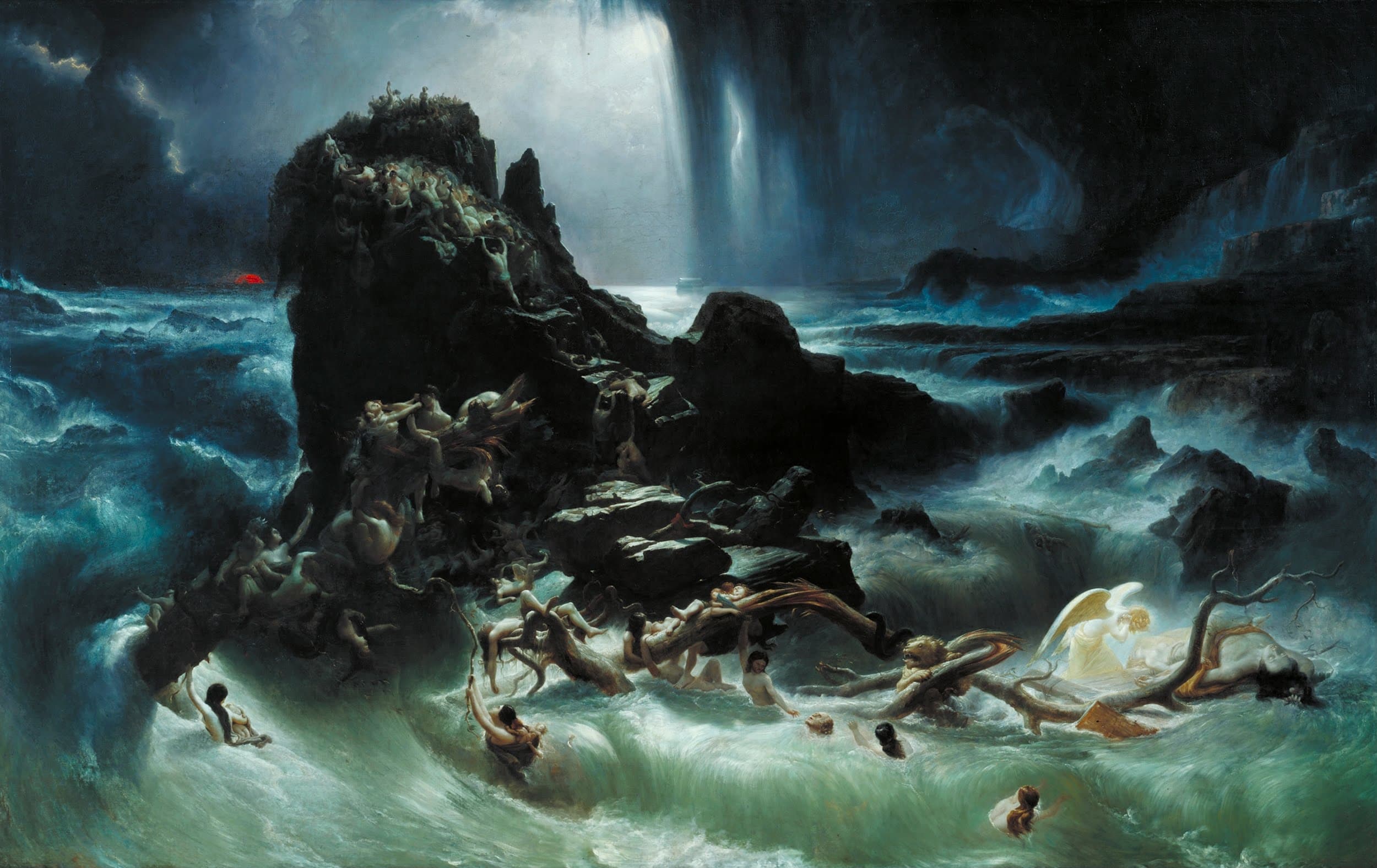
From our pressurized stasis, apocalypse appears to be the only path forward. Stop me if you’ve heard this one before: “It is easier to imagine the end of the world than to imagine the end of capitalism.” It is easier to imagine the end of the world than to imagine the end of postmodernity. It is easier to give in to violent fantasies of tsunamis and wildfires, of cartoon villains presiding over city-sized factory floors. For the same reason, the futurity we do see often reeks of utopia, the inversion of this impulse. Either everything will be terrible or everything will be wonderful. Please ignore that nothing has ever been either way before. In both cases, we remain in the land of representations, of a continued present cursed with an impossible progression, every train rumbling down the tracks instead of switching rails.
On TikTok, I see a certain creator’s animations of an impossible cyberpunk city. Blue and purple neon douse the streets, polygonal women smoke ten-pixel cigarettes from their balconies, cars fly in cubic grids overhead. The captions tend toward regret. “Still annoyed I won’t experience this </3,” “Somewhere this timeline exists,” “We were born too early to see it, too late to build it.”
Are we so early? While these animations defy the laws of physics, one sees the aesthetics of Chinese megacities like Chongqing and Shenzhen within them, or the blend of urban concrete with verdant greenery inspired by Singapore and Rio de Janeiro. Glimpses of New York, Moscow, Dubai. Whether the reader personally enjoys these aesthetics is another matter, but are we really that far from the utopian/dystopian future envisioned in science fiction? This world of tomorrow is abandoned before being allowed to flourish, any inspiration undercut by its assumed futility. Hell, a TikTok aping Blade Runner seems like one of the more likely outcomes of the current moment. Even a fiction of the future announces how infeasible it is, how whatever this creator’s 55,000 followers find appealing about their work must be absent from the real world — in case anyone gets any highfalutin notions that we were born in time to “build” and “see” the cybernetic timeline.
We have a moral duty to picture the future, flawed as it undoubtedly will be. We have a moral duty to commit ourselves to paths of action that stretch into yesterday and tomorrow, situating us temporally beyond the ephemera of the present. We have a moral duty to disagree, to fight for our visions, to fall short of utopia and end up with a real futurity. For it is only through these imaginaries, forced into realism by our actions to create them, that we shape this world. We would all be so lucky if the great wave or second coming of Christ might tomorrow sweep us into our afterlives and settle earthly questions once and forever. Alas, we are blessed and condemned to be active subjects — the tech billionaires know this, the politicians know this, and no mass movement survives without inscribing this self-fulfilling truth into the collective consciousness.
In Jameson’s critique of postmodernism, he reproduces a poem by Bob Perelman titled “China.” Ironically, (considering Jameson’s rather critical appraisal of the piece) its final couplet has stayed with me since reading:
Time to wake up.
But better get used to dreams.
(Perelman, “China,” in Jameson, p. 31)
Yes, it is time to wake up. It is time to wake up from the paralysis, from “humanity is doomed,” from casual apocalypticism. It is time to wake up from fantasies of Armageddon, whether taken from the Quran or from the Divergent books. Yet still, we better get used to dreams, productive dreams, dreams of a life with narrative purpose, dreams of culture that flows onward instead of stagnating. In a virtually-mediated eternal present, choose to imagine a future rather than burrowing into nostalgia for a fetishized past. Jameson, as a Hegelian Marxist, encourages readers to “think of the cultural evolution of late capitalism dialectically, as catastrophe and progress all together” (Jameson, p. 47). Neither despair nor exaltation. As the end is built into the beginning, so too does the ending of our grand récit provide fertile ground for a new story. It will be written, whether we believe in it or not. We will seize this opportunity only if we unify thought and action, if we dream and do, dreaming while doing and doing while dreaming.
Apocalypse is passé. A dead meme. The future stares us down from the shadows, breath hot against our necks, begging to be acknowledged, ours to tame.
Works Cited
Billet, Matthew I., et al. “End of World Beliefs Are Common, Diverse, and Predict How People Perceive and Respond to Global Risks.” Journal of Personality and Social Psychology, 2026.
Gramsci, Antonio. Quaderni del Carcere. Translated and edited by Joseph A. Buttigieg, vol. 3, Columbia University Press, 2007.
Hickman, Caroline, et al. “Climate anxiety in children and young people and their beliefs about government responses to climate change: a global survey,” The Lancet Planetary Health, 5, 2021.
Jameson, Fredric. Postmodernism, or, the Cultural Logic of Late Capitalism. Duke University Press, 1991.
Lyotard, Jean-François. The Postmodern Condition: A Report on Knowledge. Translated by Geoffrey Bennington and Brian Massumi, University of Minnesota Press, 1984.